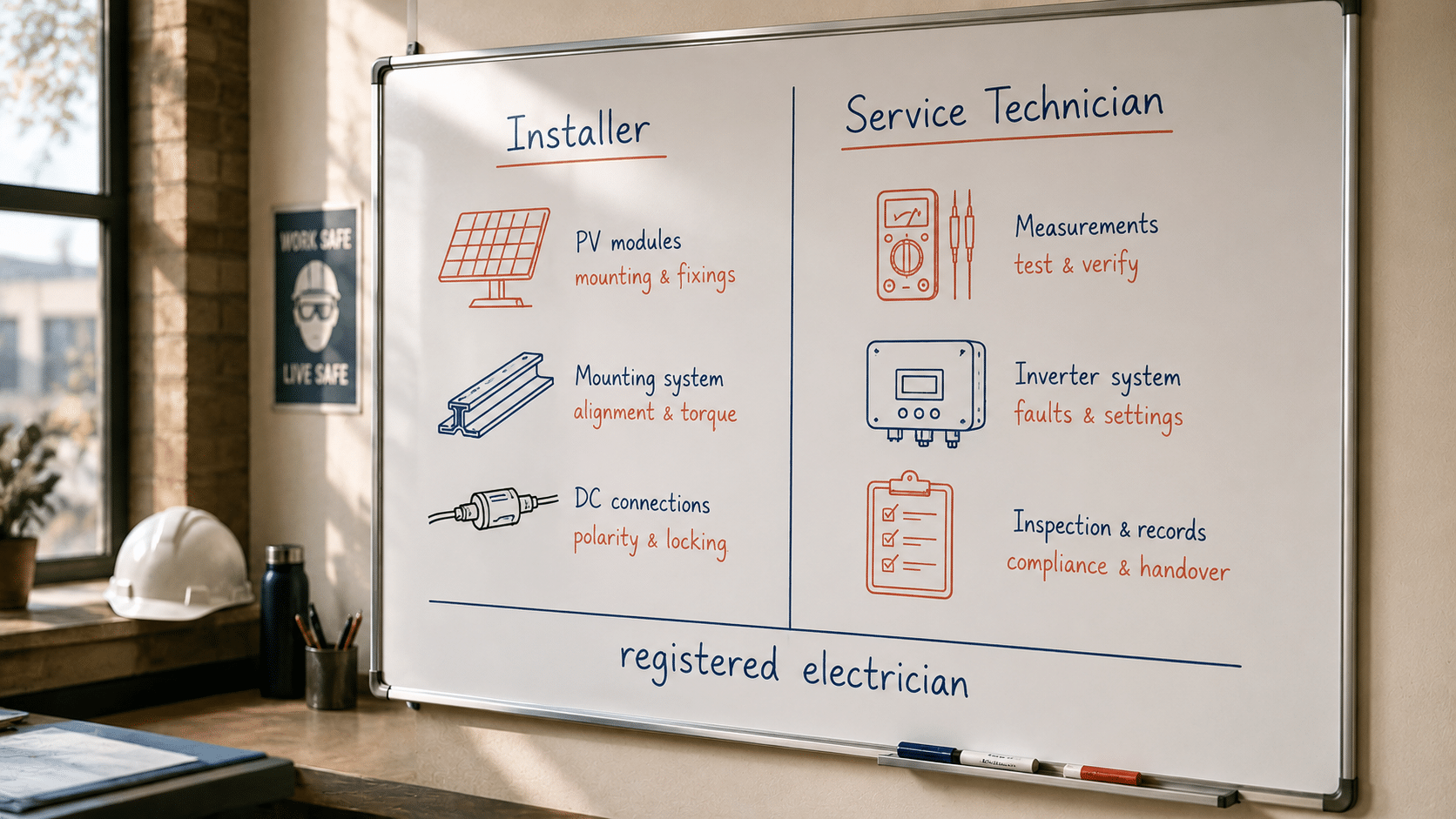
PV installer vs service technician is the wrong way to frame the choice for most people coming into solar — these are two different jobs at two different qualification levels, not two labels for the same role. If you are mapping a solar career or building an installation team, start with our guide to the Solar PV Service Technician course in Gauteng, then read on.
This guide is written for two readers: the person choosing which solar training to do, and the employer deciding who to put on which task. It builds on our breakdown of the PV GreenCard versus the QCTO solar qualification, and it stays practical — what each person touches on site, what each can sign off, and where the lines legally stop.
Quick Answer
The PV installer vs service technician distinction is about scope and level. An installer typically mounts panels, racking and DC components and is most often certified through SAPVIA’s voluntary PV GreenCard route. A QCTO Solar PV Service Technician holds a full NQF Level 5 occupational qualification (SAQA 99447) that adds system commissioning, fault diagnosis and servicing. Neither qualification, on its own, makes you a registered electrician — the final grid connection still belongs to someone else.
Not sure which solar role your team actually needs to hire for?
Talk it through with the campus teamPV Installer vs Service Technician: What Each Role Does on Site
Picture a rooftop job. One person is on the roof setting out rails, clamping modules, running DC string cabling and labelling the array. That is installer work — physical, methodical, and centred on getting panels mounted safely and correctly. It is the visible part of solar, and for many sites it is where a career starts.
Now picture the same system three months later, tripping intermittently in the early evening. Diagnosing that fault is not installer work. It needs someone who understands the whole chain — array, inverter, protection, monitoring — and can isolate where the problem sits. That is the service technician’s territory, and it is a deliberately broader competence.
The simplest way to hold the difference in your head: an installer puts the system up, a service technician keeps it working over its life. The roles overlap on a good site, but the qualifications behind them are not the same depth, and that matters the moment something goes wrong.
Safety adds another layer people miss. Installation work carries real DC risks — arc faults, reversed string polarity, badly torqued connections. Servicing work carries those plus the judgement calls of an energised, ageing system. The deeper qualification exists partly because the consequences of getting servicing wrong are harder to spot and slower to surface.
| Task area | Installer (typical) | Service Technician (typical) |
|---|---|---|
| Mechanical mounting | Yes — core task | Yes — plus checks the mounting against load and spec |
| DC side wiring and strings | Yes — to design | Yes — and verifies the design assumptions |
| Commissioning and testing | Limited / supervised | Yes — owns the commissioning record |
| Fault-finding and servicing | Basic | Yes — the defining competence |
| AC grid connection / CoC | No | No — registered electrician only |
The line nobody can cross without a wireman
Both roles stop at the same point: the live AC connection to the distribution board and the Certificate of Compliance. That work is reserved for a Department of Labour-registered electrician. We cover that pathway in full in our wireman’s licence guide — read it before you assume any solar qualification lets you energise a system.
Where the Two Roles Overlap — and Where They Don’t
On a well-run site the installer and the technician are not strangers. The technician often checks the installer’s work before commissioning, and a sharp installer picks up plenty by watching how faults get traced. The overlap is real, and it is where good teams quietly get built.
Where they part company is responsibility. An installer is accountable for the work they physically did. A service technician carries the system as a whole — its performance, its safety margins, its behaviour over years. That move from task to system is the heart of the difference, and no amount of installation experience substitutes for it.
That distinction matters for hiring more than job titles do. Two CVs can both say “solar” yet describe very different capabilities. Asking what someone has actually commissioned and serviced — not just mounted — tells you fast which side of this line they sit on.
PV Installer vs Service Technician: How the Qualifications Differ
Here is where most confusion lives. The installer route in South Africa is most commonly the SAPVIA PV GreenCard — a short, industry-run certification built around a few days of training and a competency assessment, with a per-install report attached to it. It is genuinely useful and widely recognised, but it is a voluntary industry credential, not a registered NQF qualification.
The service technician route is different in kind. The QCTO Solar PV Service Technician is a full occupational qualification at NQF Level 5, registered on the SAQA framework as 99447. It runs over a structured programme of knowledge, practical workshop hours and workplace exposure, and ends in an external assessment rather than a single competency check.
That difference in design is the whole story. A short certification proves you can perform a defined set of installation tasks today. An occupational qualification builds a technician who can reason about a system they have never seen before — which is exactly what servicing demands. Practitioners who want to keep building above either level can pursue continuing professional development through bodies like the SAIEE Training Academy.
For an employer, the practical read is straightforward. If you only ever mount and walk away, the installer credential covers the work. If you offer maintenance contracts, warranties or servicing — anything where you are responsible for the system over years — you need technician-level competence on the team, not just installation hands.
It helps to look at how each is assessed. The installer route closes with a competency assessment against a defined task list — can you do these things, to standard, today. The occupational qualification closes with an external assessment that tests reasoning across the system, on top of logged workshop and workplace hours. One confirms a skill set; the other certifies a rounded technician.
Workplace exposure is the other divider. The occupational route deliberately builds in supervised time on real systems, so a technician has met failure modes before facing them alone. A short course cannot replicate that, and it does not try to — it is built for a narrower, faster purpose.
Building a solar team and weighing GreenCard installers against QCTO technicians?
Map the roles with us firstWhat Changes When You Move From Installer to Qualified Technician
The clearest argument for the longer route is what it does to a person’s working scope and value. An installer who completes the QCTO Solar PV Service Technician qualification does not lose the installation skill — they add the diagnostic and servicing layer on top, and that changes the kind of work they can be trusted with and billed out for.
That added layer also changes who will employ you. A market that is shifting from new installs toward servicing existing systems rewards people who can do both, and it quietly sidelines those who can only mount. The qualification is, in effect, insurance against a slow installation month.
The table below is illustrative rather than a price list — actual rates vary by employer, region and contract. It shows the direction of travel we see when someone moves from installation-only work into a full occupational qualification.
| Metric | Before (installer only) | After (QCTO technician) | Shift |
|---|---|---|---|
| Work scope | Mounting and DC assembly | Full system commissioning and servicing | Broader |
| Recognised credential | Industry certification | NQF Level 5 occupational qualification | Formal NQF standing |
| Maintenance-contract eligibility | Limited | Yes — can own servicing | + revenue line |
| Employability across employers | Project-dependent | Higher — qualification travels | More secure |
Which one do you need?
Choosing for a career: if you want the fastest route onto a site, an installer certification gets you working sooner. If you want a credential that travels and opens servicing and supervisory roles, the QCTO Solar PV Service Technician qualification is the stronger long-term bet. Choosing as an employer: hire installers for build-out volume, and put at least one qualified technician on anything you have to maintain or warrant.
PV Installer vs Service Technician: Choosing Your Route
When you are early in a solar career, the honest trade-off is speed against ceiling. The installer route gets you earning on site sooner, which matters when income cannot wait. The technician route asks for more time but lifts the ceiling on what you can do, and what you can charge, later on.
Employers face the mirror image of that trade-off. A pure build-out company can run mostly on installers and bring in technician competence for sign-off. A company selling maintenance, monitoring or warranties cannot — servicing revenue depends on people who can diagnose, and that capability has to live on staff, not be borrowed in.
There is no single right answer here, only a right fit for the goal in front of you. Name the goal first — fast entry, or durable scope — and the route tends to choose itself.
Who This Is NOT For
Honesty up front saves everyone money. There are a few situations where neither of these solar routes is the right first move, and it is worth naming them plainly.
You actually need to be the registered electrician
If your goal is to sign Certificates of Compliance and energise systems yourself, no solar installer or service technician qualification gets you there. That is the electrical trade and wireman’s licence pathway — a different programme with a different endpoint.
You want a weekend certificate and a guaranteed salary
The installer route is short, but it is still a competency assessment with real standards, and it does not promise placement. The technician route is longer still. Neither is a shortcut to a fixed income with no further effort.
You are buying compliance, not capability
If the only aim is a certificate to wave at a client, both routes will disappoint. They are built to produce people who can do the work, and assessors test for that. Treat them as capability-building, not paperwork.
Why Phambili Builds the Full Service Technician, Not Just the Installer
We made a deliberate choice. Phambili Village Campus runs the QCTO Solar PV Service Technician occupational qualification (SAQA 99447) rather than only the short installer route, because the maintenance and servicing side is where South Africa’s solar boom is now creating the most durable work. You can see the programme detail on our Solar PV Service Technician programme page.
The reason is operator experience, not theory. As an accredited Skills Development Provider (SDP 07-QCTO/SDP190625142451), we watch where placed learners end up adding value — and increasingly it is on the systems already on roofs across Gauteng, not just the new ones going up. A technician who can service is employable through a quiet installation month in a way an installer-only candidate often is not.
It also sits inside a B-BBEE skills-development story for the employers we work with. A registered NQF Level 5 occupational qualification carries weight on the scorecard that a short industry certificate does not, which matters when a company is planning its solar workforce and its compliance in the same breath.
We see it most clearly at intake in Gauteng. Learners who arrive with installation experience but no formal qualification are common, and the ones who commit to the full NQF Level 5 route are the ones employers come back asking for by name. That pattern, more than any brochure, is why we run the qualification we do.
None of this makes the installer route lesser. It is the right first step for many people, and we respect it. The point is narrower: we built our programme around the role that, in our placement experience, gives a learner the most durable footing in a fast-moving market.
Want to see how a full QCTO solar qualification fits your workforce plan?
Book a conversation with the campusFrequently Asked Questions
Is a PV installer the same as a solar PV service technician?
No. An installer focuses on mounting panels and assembling the DC side of a system, usually certified through a short industry route. A service technician holds a broader occupational qualification that adds commissioning, fault-finding and servicing across the whole system.
Does the PV GreenCard make me a qualified technician?
The PV GreenCard is a voluntary SAPVIA industry certification focused on installation competence. It is valuable for installation work, but it is not a registered NQF qualification and does not on its own make you a QCTO Solar PV Service Technician.
Can either role connect a solar system to the grid?
No. The live AC connection and the Certificate of Compliance are reserved for a Department of Labour-registered electrician. Both the installer and the service technician must hand that final step to a registered person.
What NQF level is the QCTO Solar PV Service Technician qualification?
It is an occupational qualification at NQF Level 5, registered on the SAQA framework as 99447. It is a full qualification rather than a short certificate, which is why it covers servicing as well as installation.
Which route should an employer hire for?
Hire installers when the priority is build-out volume on new systems. Put at least one qualified service technician on any work you have to maintain or warrant, because servicing and fault diagnosis sit beyond the installer scope.
Can an installer upgrade to a service technician later?
Yes. Installation experience is a strong foundation, and many people move from installer work into the full occupational qualification. The technician route adds the diagnostic and servicing competence on top of the installation skill they already have.
Still weighing whether to train installers or build full technicians for your renewable energy work? That decision is easier with someone who places these learners every intake, not harder.
Get a clear solar skills recommendation for your team
Tell us what your solar work looks like and we will map which roles — installer, technician, or both — actually fit, and how the QCTO route supports your B-BBEE scorecard.
No obligation. We will get back to you within 24 hours.
Get in touch