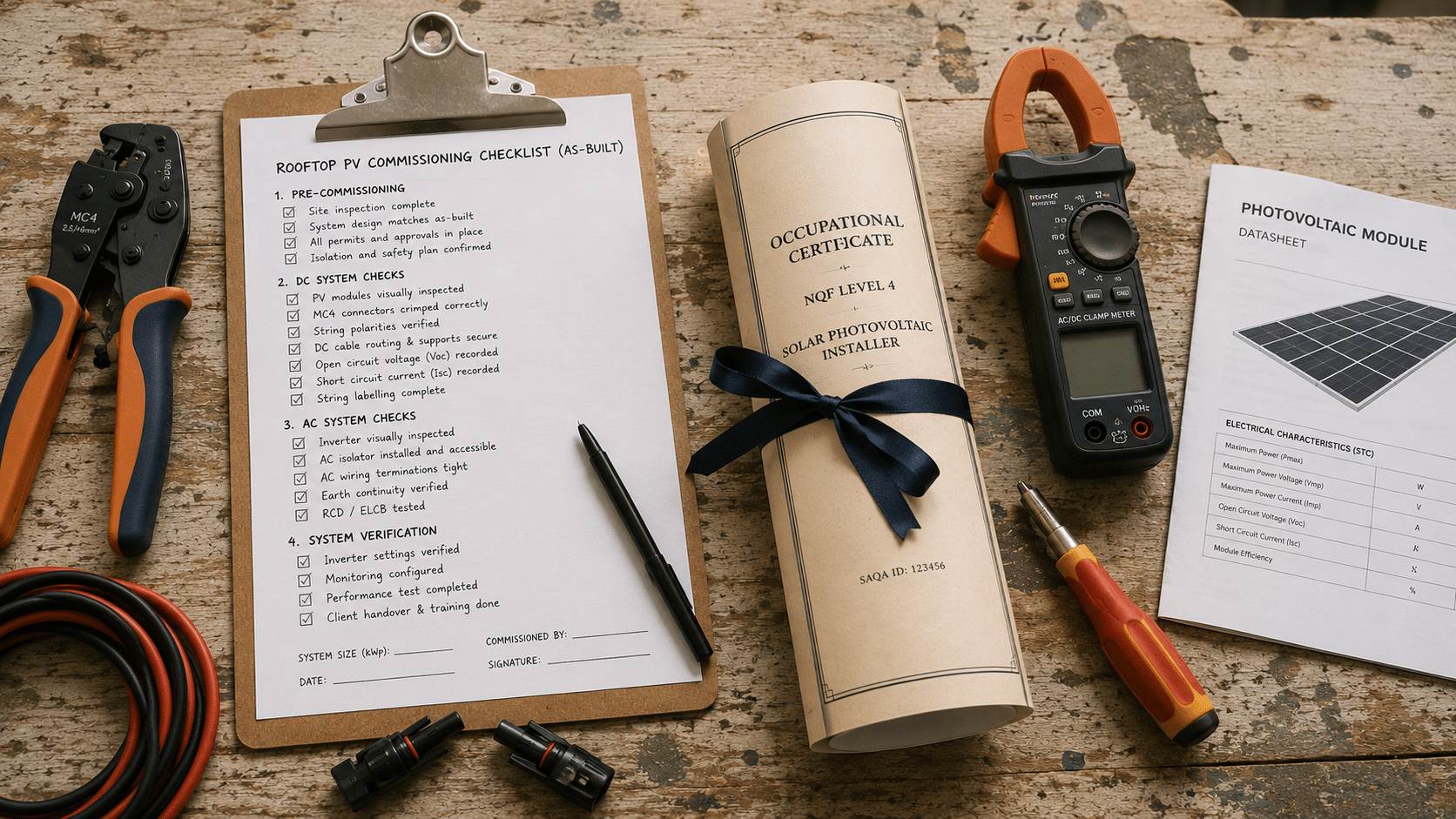
Almost everyone entering the solar trade trips over the PV GreenCard vs QCTO solar qualification question, because the two get talked about as rivals for the same slot. Our complete guide to the solar PV service technician course in Gauteng covers the qualification side in full.
They are not rivals. One is an industry quality certification for installers; the other is a full occupational qualification on the national framework. Confusing them costs installers time and employers money.
This guide is for the installer or career-changer deciding where to spend their time and money, and for the employer building a compliant, fundable solar team. Both need to see why these two credentials sit at different levels and do different jobs. For the accreditation backdrop, see our guide to QCTO-accredited training in Gauteng.
Quick Answer
There is no either/or in the PV GreenCard vs QCTO solar comparison. The GreenCard is SAPVIA’s voluntary industry certification — a short course plus a competency assessment that proves you can install rooftop PV to standard and issue an as-built quality report. The QCTO Solar PV Service Technician (SAQA ID 99447, NQF Level 5) is a full NQF-registered occupational qualification. The GreenCard certifies a skill; the QCTO qualification builds the technician underneath it.
Not sure whether your installers need the GreenCard, the QCTO qualification, or both?
Ask the campus teamWhat the PV GreenCard Actually Is
The PV GreenCard is an industry-led quality-assurance programme run by SAPVIA, the South African Photovoltaic Industry Association. It was introduced in 2017 to standardise rooftop solar installation quality, and it has two faces: a certification for installers, and an as-built report issued for each completed installation.
Becoming certified is comparatively quick. An installer typically completes a short SAPVIA-aligned installer course of roughly a week, then sits a two-day competency assessment — theory plus a practical on a simulated roof — to qualify as a SAPVIA PV GreenCard Installer. Certified companies are listed on the public GreenCard database that clients, banks and insurers increasingly check.
One detail trips people up. A PV GreenCard is issued by a certified company, but the electrical connection and certificate of compliance still require a Department of Labour-registered electrician. The GreenCard certifies PV installation quality; it does not replace electrical registration. You can read SAPVIA’s own description of SAPVIA’s PV GreenCard programme for the official framing.
In short, the GreenCard is a market-access credential. It is voluntary on paper, but in practice it has become close to expected for anyone wanting serious rooftop work, because it gives clients a recognised seal that the job was done to industry standard.
The as-built report is the other half of the programme, and it is easy to overlook. For each completed job a certified installer issues a GreenCard documenting the system design, the components used and the expected performance — a standardised handover that gives the client, the insurer and any future technician a clear record of exactly what went onto the roof.
What the QCTO Solar PV Qualification Actually Is
The QCTO Solar PV Service Technician is a different animal entirely. It is a full occupational qualification — SAQA ID 99447 at NQF Level 5 — registered on the national framework and quality-assured by the QCTO. Where the GreenCard certifies a specific installation skill, this qualification builds the broader competence of a technician who can install, commission, service, maintain and fault-find PV systems.
Because it is a registered occupational qualification, it carries weight the GreenCard cannot. It combines knowledge, practical and workplace components and concludes with an external assessment, the structure common to every QCTO occupational route. If the framework itself is unfamiliar, our explainer on the QCTO occupational qualification framework sets out how these qualifications are built.
That breadth is the point of a Level 5 qualification. A service technician is expected to diagnose an underperforming array, replace a failed inverter and commission a system correctly — not only mount panels. It is the gap between someone who can complete an installation and someone who can keep a fleet of them running for years.
Employers read that level instantly. An NQF Level 5 occupational certificate tells a hiring manager the holder has been externally assessed against a national standard, which is a stronger signal in a tender or a B-BBEE submission than an industry card on its own. Recognition like that compounds across a career.
The Real Difference
The GreenCard is a short, voluntary industry certification focused on rooftop installation quality and a per-job report. The QCTO Solar PV Service Technician is a full NQF Level 5 occupational qualification covering the whole service-technician role. One is a market-access seal; the other is a formal, framework-registered qualification — which is exactly why employers treat them so differently.
It also matters for funding and compliance. Because the QCTO qualification is NQF-registered and learnership-eligible, money spent training learners on it earns B-BBEE Skills Development scorecard points, as our guide to B-BBEE skills development scorecard points explains. A short voluntary certification does not carry the same scorecard weight.
PV GreenCard vs QCTO Solar: The Real Difference at a Glance
Laid side by side, the two credentials stop looking like competitors and start looking like different tools. The table below sets out where each one sits.
| Dimension | PV GreenCard | QCTO Solar PV Service Technician |
|---|---|---|
| What it is | Voluntary industry certification + as-built report | NQF-registered occupational qualification |
| Who runs it | SAPVIA (industry association) | QCTO (statutory quality council) |
| NQF level | Not NQF-registered | NQF Level 5 (SAQA 99447) |
| Typical length | About a week plus a 2-day assessment | A formal qualification over a far longer period |
| Scope | Rooftop PV installation quality | Install, commission, service, maintain, fault-find |
| B-BBEE / learnership value | Limited | Learnership-eligible, earns Skills Development points |
| Electrical connection / CoC | Still needs a registered electrician | Still needs a registered electrician |
| Best for | Fast market access for working installers | Building a formally qualified technician |
The pattern is consistent: where the qualification wins, it is about durability and recognition, while the GreenCard’s strength is speed to market. That is the whole PV GreenCard vs QCTO solar decision in miniature. Speed has real value, but so does a credential that still means something in five years.
Notice the one row that is identical: neither credential makes you a registered electrician. The grid connection and certificate of compliance always require electrical registration, which is why solar and electrical skills sit so close together — a point our guide to the wireman’s licence pathway picks up.
Building a solar team and want a formal, B-BBEE-eligible qualification under it?
Map the qualification with usPV GreenCard vs QCTO Solar: Which One Do You Actually Need
For a working installer who already has electrical backing and needs market access now, the GreenCard is the faster, cheaper move. It gets you on the database clients check and signals quality without committing years to a qualification.
For someone building a career, or an employer building a team meant to last, the QCTO qualification is the foundation. It produces a technician with genuine breadth, it is recognised on the national framework, and it unlocks the funding and B-BBEE value that a voluntary certification does not.
The strongest position, honestly, is both. A QCTO-qualified technician who also holds a PV GreenCard has the formal competence and the market-facing seal — and that combination is what the better solar employers are actively recruiting. Framing the PV GreenCard vs QCTO Solar PV choice as a contest misses that they stack.
Cost frames the decision too. A GreenCard assessment is a modest, one-off outlay measured in a few thousand rand, while a full qualification is a larger investment of time and money. But the cheaper credential also delivers less — narrower scope, no NQF standing and no funding benefit — so the lower price is not the whole story.
Which One Do You Need
A working installer who needs market access now and already has electrical backing? The GreenCard is the fast move. Building a career, or a team meant to last? Lead with the QCTO Solar PV qualification and add the GreenCard on top. For most serious solar employers, the honest answer is both — in that order.
| Factor | Before — GreenCard-only hire | After — QCTO-qualified pipeline | Net effect |
|---|---|---|---|
| B-BBEE Skills Development value | Little to no scorecard credit | Learnership spend earns points | Scorecard gain |
| Technician breadth | Install-focused | Install, service and maintain | More deployable team |
| Formal recognition | Industry seal only | NQF Level 5 qualification | Recognised credential |
| Pipeline durability | Hire-to-hire | Home-grown technicians | Lower turnover |
Who This Comparison Is NOT For
This comparison assumes you are weighing solar PV credentials as an installer or an employer. A few readers should look elsewhere first.
If you need to do the electrical connection yourself
Neither the GreenCard nor the QCTO Solar PV qualification registers you as an electrician. If your goal is to sign off the grid connection and issue a certificate of compliance, you need the electrician pathway, not a solar credential. Start there and add solar afterwards.
If you only ever want to issue an as-built report once or twice
A homeowner or hobbyist curious about a single installation does not need either credential. Both are for people working in the trade. Reading the SAPVIA guidelines and using a certified installer is the right route for a one-off project, not enrolling yourself.
If you want a guaranteed qualification with zero practical work
Both routes are hands-on by design. The GreenCard assessment puts you on a simulated roof, and the QCTO qualification is built around practical and workplace components. Anyone hoping for a paper certificate without demonstrating real installation competence will not find it here.
Why Phambili Builds the Full QCTO Solar PV Technician Behind the Certificate
Phambili Village Campus trains the QCTO Solar PV Service Technician qualification, and we are deliberate about which side of this comparison we sit on. As a QCTO-accredited Skills Development Provider — accreditation number 07-QCTO/SDP190625142451 — our focus is the formal, framework-registered qualification, not a quick certificate alone.
The reasoning is the one an employer eventually reaches anyway. A short certification gets a person onto a roof, but it does not build the depth to service and fault-find systems years later, and it does not earn the B-BBEE and funding value that makes a pipeline affordable. The qualification does both, and the certificate can sit on top of it.
That is the operator’s read on the GreenCard versus the QCTO route. We are not dismissive of the GreenCard — it is a sensible market-access step — but we build the technician first, because the technician is the durable asset and the certificate is the finishing touch. Demand for solar skills rewards depth, not just speed.
Crucially, it is the route that survives contact with a real client base. A solar firm that wins a maintenance contract needs technicians who can service and fault-find, not only install — and that is competence a qualification builds and a short certificate cannot. We train for the work that comes after the panels are up, because that is where solar businesses actually live or die.
Planning a renewable-energy skills pipeline and weighing the qualification options?
Plan the pipeline with usFrequently Asked Questions
Is the PV GreenCard a qualification or a certification?
It is a certification, not an NQF-registered qualification. The PV GreenCard is SAPVIA’s voluntary industry quality-assurance programme: a short course and a competency assessment that certify an installer and allow a certified company to issue an as-built report. It proves installation competence to the industry, but it does not sit on the national qualifications framework the way the QCTO qualification does.
Does the QCTO Solar PV qualification make me a registered electrician?
No. The QCTO Solar PV Service Technician qualification builds technician competence to install, service and maintain PV systems, but the electrical connection to the grid and the certificate of compliance still require a Department of Labour-registered electrician. Solar PV and electrical registration are related but separate, which is why many people pursue both pathways over time.
Can I hold both the PV GreenCard and the QCTO qualification?
Yes, and that is the strongest position. The QCTO qualification gives you formal, NQF-registered technician competence, while the GreenCard gives you the market-facing seal that clients, banks and insurers recognise. Holding both means you have the depth employers want and the credential the market checks, which is exactly the combination the better solar firms recruit for.
Which one earns B-BBEE points for an employer?
The QCTO qualification. Because it is NQF-registered and learnership-eligible, money spent training learners on it counts toward B-BBEE Skills Development scorecard points. The GreenCard, as a short voluntary certification, does not carry the same scorecard weight, so an employer thinking about compliance and funding generally builds on the QCTO route.
Is the PV GreenCard compulsory in South Africa?
It is voluntary in law, but in practice it has become close to expected for serious rooftop solar work. Many clients, financiers and municipalities now prefer or require a PV GreenCard as a sign of quality and safety, so installers who want consistent work usually treat it as a practical necessity rather than an optional extra.
Should an employer choose the GreenCard or the QCTO route for a new team?
For a durable team, build on the QCTO qualification and add the GreenCard on top. The qualification gives technician breadth, formal recognition and B-BBEE value; the certification gives market access. Relying on the GreenCard alone produces installers without the depth or the funding benefit, so most employers planning for the long term lead with the qualification.
Worried a full QCTO qualification is overkill when a GreenCard gets installers on roofs faster? The two are not rivals — the GreenCard certifies a skill, the QCTO qualification builds the technician underneath it, and the strongest installers carry both.
Build QCTO-Qualified Solar PV Technicians for Your Team
Tell us about your solar workforce or your B-BBEE skills development goals, and we will map a QCTO Solar PV Service Technician pipeline — and show where a PV GreenCard fits on top of it.
No obligation. We will get back to you within 24 hours.
Get in touch