The SAPVIA PV GreenCard assessment is a voluntary industry competency test that certifies a solar installer’s work — and it sits alongside, not instead of, a formal QCTO qualification. If you are working out how it fits a solar career or a hiring plan, start with our guide to the Solar PV Service Technician course in Gauteng and read on.
This guide is written for two readers: the installer deciding what to do next, and the employer trying to read what a GreenCard on a CV actually proves. It builds on our comparison of the PV GreenCard versus the QCTO solar qualification, and answers one question — where does this assessment sit in the wider training picture?
Quick Answer
The SAPVIA PV GreenCard assessment is a two-day theoretical and practical test, usually taken after a short installer course, that adds a passing installer to SAPVIA’s certified database. It is a quality-assurance credential, not an NQF qualification. The QCTO Solar PV Service Technician occupational qualification (SAQA 99447, NQF Level 5) is the formal route — and GreenCard experience can later feed into it through recognition of prior learning.
Unsure whether your installers need a GreenCard, a QCTO qualification, or both?
Map the right path with the campus teamWhat the SAPVIA PV GreenCard Assessment Actually Is
Strip away the brand name and it is a competency check. An installer who already has training and site experience presents for a structured assessment, proves they can install a grid-tied rooftop system to standard, and — on passing — joins a public database of recognised installers. Banks, insurers and clients increasingly look for that listing before they trust a quote.
For the installer, the payoff is visibility. That public database is searchable by clients, and a current listing works as a low-friction trust signal — particularly in a market where homeowners have learned to be wary about who they let onto a roof and whose wiring they live above.
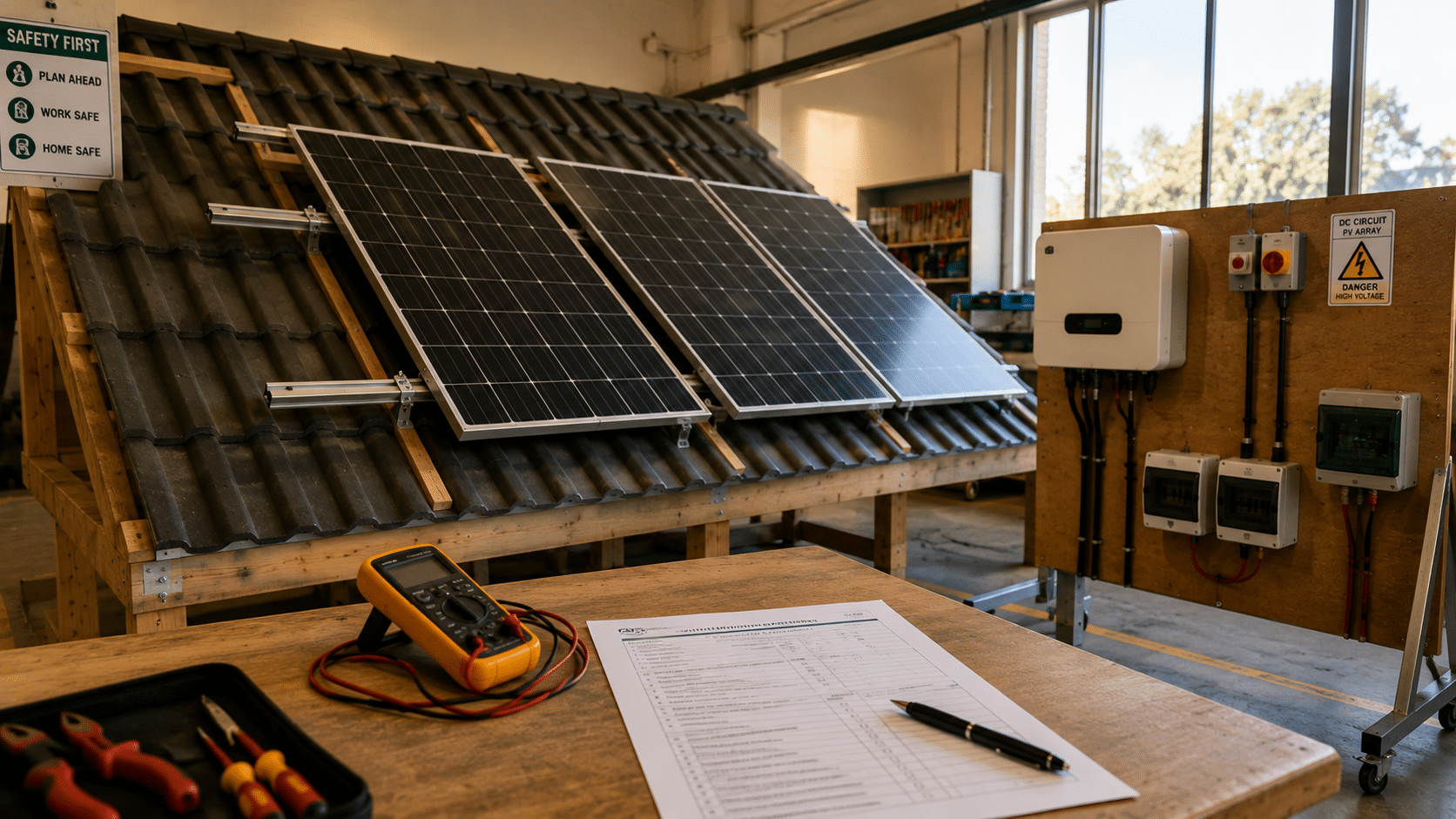
The assessment usually runs over two days at a SAPVIA-endorsed centre. It pairs a theory paper with a practical task on a simulated roof rig, and candidates need a solid combined pass to qualify. Most people prepare with a short solar PV installer course first, because the assessment tests applied competence, not classroom recall.
There is also a deliverable attached to the credential. A certified installer issues a per-installation “as-built” report — the actual GreenCard — documenting the components used and confirming each step was completed correctly. That document is what a homeowner or financier keeps as proof of a compliant install. You can read SAPVIA’s own account of the PV GreenCard programme for its origin and intent.
Day-to-day the assessment is not run by SAPVIA itself. It is delivered through SAPVIA-endorsed centres around the country, several attached to established solar academies. That network is why an installer in Gauteng can sit the same standardised assessment as one in Cape Town and land in the same national database.
What does it actually test? On the theory side it covers system design basics, safety, standards and the reasoning behind a compliant layout. On the practical side, candidates physically mount and wire a system on a rig and are marked on workmanship. It is deliberately hands-on, which is why cold attempts rarely pass.
Cost varies by assessment centre, but candidates should currently budget in the region of R5,000 to R6,000 excluding VAT for the assessment itself, separate from any preparatory course. Treat that as indicative — confirm the figure with the centre before booking, since it moves with the centre and the package.
| Element | What it involves |
|---|---|
| Format | Two-day theoretical and practical assessment at an endorsed centre |
| Prerequisite | Recommended: a short solar PV installer course plus site experience |
| Pass outcome | Listing in SAPVIA’s certified installer database |
| Ongoing deliverable | A per-install “as-built” GreenCard report for each client |
| Status | Voluntary quality-assurance credential — not an NQF qualification |
What it is, and what it is not
The GreenCard proves installation competence and produces a quality paper trail clients value. It does not register you as an electrician, and it does not place you on the national NQF framework. Issuing GreenCards in practice still depends on working under a Department of Labour-registered electrician — the credential complements electrical registration rather than replacing it.
Why the SAPVIA PV GreenCard Assessment Exists
South Africa’s rooftop solar boom created a quality problem before it created a skills system. Systems went up fast, some of them badly, and clients, insurers and banks had no easy way to tell a competent installer from a risky one. The GreenCard was the industry’s answer to that gap.
It was developed by SAPVIA with international partners to set a common standard and a verifiable record. The aim was straightforward: a database clients could trust, and a per-install report that travels with the system. That origin explains why the credential is about assurance and documentation, not formal education.
Although it stays voluntary, the GreenCard has drifted toward being expected. Financiers and insurers increasingly ask for it, and some clients will not proceed without one. That market pull, rather than any regulation, is what gives the credential its real weight today.
That history also matters when you read the credential’s limits fairly. It was built to certify installation quality and create a paper trail, and it does that well. Expecting it to also confer NQF standing or electrical registration is asking it to do a job it was never designed for.
Where the SAPVIA PV GreenCard Assessment Fits With QCTO Training
Think of it as two layers doing different jobs. The GreenCard is an industry quality-assurance layer that says “this person installs to standard, and here is the report to prove it.” The QCTO Solar PV Service Technician qualification is the formal, NQF-registered layer that builds a rounded technician who can also commission, diagnose and service over a system’s life.
They are not rivals. An installer can hold a GreenCard and pursue the occupational qualification, and the two reinforce each other — practical installation credibility on one side, formal recognised standing on the other. For a serious solar career, having both is stronger than choosing between them.
There is a direct bridge between the two as well. The GreenCard assessment model helped inform the recognition-of-prior-learning approach for the service technician qualification, which means real installation experience need not be discarded when someone moves toward the formal route. Documented competence can shorten the distance to a full qualification.
The practical distinction is what each prepares you to be trusted with. A GreenCard says the installation will be done to standard and documented. The qualification says the person can also judge, commission and repair the system long after the installer has left the roof. Employers feel that difference most on maintenance contracts.
A useful way to picture it: the GreenCard is a competency test for a specific job, while the QCTO qualification is the broader grounding to work across conditions. Both are real and both are earned, but they certify different breadth. Confusing the two is where most career missteps begin.
Want to turn your installers’ GreenCard experience into a recognised QCTO qualification?
Ask us about the RPL pathwayWhat Changes When You Add the QCTO Qualification
The GreenCard answers the question “can this person install safely today.” The occupational qualification answers a bigger one — “can this person carry a solar system over its working life.” Adding the QCTO layer on top of GreenCard competence is what turns a capable installer into a technician an employer can build a service offering around.
The shift below is directional rather than a guarantee; actual outcomes depend on the employer and the work. It shows what the formal qualification adds to someone who already holds the GreenCard credential.
The biggest change is who will employ the person, and for what. An installer with a GreenCard competes for installation work. A technician who also holds the QCTO qualification competes for the servicing and supervisory work that does not dry up when new installations slow — which, in a maturing solar market, is increasingly where the steady income sits.
| Metric | Before (GreenCard only) | After (GreenCard + QCTO) | Shift |
|---|---|---|---|
| Formal NQF standing | Industry credential only | NQF Level 5 occupational qualification | Formal recognition |
| Scope of competence | Installation and quality reporting | Installation plus commissioning and servicing | Broader |
| B-BBEE scorecard weight | Limited | Counts as a registered qualification | Scorecard value |
| Recognition across employers | Database listing | Qualification that travels nationally | More portable |
How to sequence it
For most people the practical order is GreenCard first, qualification second. Get assessed, start earning on installations, then build toward the QCTO Solar PV Service Technician qualification while the experience counts toward recognition of prior learning. Employers planning a solar team can fund that sequence deliberately rather than treating the two as an either/or choice.
Reading a GreenCard on a CV: What Employers Should Check
A SAPVIA PV GreenCard assessment on a CV is useful, but it rewards a second look. Check that the installer’s listing in the SAPVIA database is current rather than lapsed, because the credential is meant to be kept live, not earned once and forgotten.
Check, too, how the person actually works. Issuing a compliant install means pairing GreenCard competence with a Department of Labour-registered electrician for the grid-side sign-off. A strong candidate understands that division of responsibility and does not pretend to cover it single-handedly.
And look at the as-built reports they produce. Those documents are the real output of the credential — clear, complete reports signal an installer who takes the quality trail seriously, which is exactly what insurers and financiers want to see.
One more thing is worth checking: recency. The standards behind a compliant installation move as equipment and codes change, so a credential earned years ago carries more weight when it sits alongside evidence of ongoing learning.
Who This Is NOT For
It is worth being blunt about where this assessment is the wrong first step, because booking it at the wrong moment wastes time and money.
You have never installed anything
The assessment tests applied competence on a real rig. Someone with no training and no site time will not pass it cold. Do a solar PV installer course and get hands-on experience first, then book the assessment.
You expect it to make you an electrician
It will not. The GreenCard sits alongside electrical registration, not above it. If your goal is to sign off the live grid connection yourself, that is the wireman’s licence pathway, and it is a separate journey entirely.
You want a single credential and nothing more
If you are building a long-term solar career, treating the GreenCard as the finish line caps your ceiling. The market rewards people who add the formal qualification on top, not those who stop at the industry credential.
How Phambili Treats the GreenCard as a Bridge, Not a Destination
We see a lot of capable installers at intake. Many arrive holding a GreenCard and real site experience but no formal qualification, and they assume the two are interchangeable. Our job is to show them how the credential they already have can become a running start toward the QCTO Solar PV Service Technician qualification rather than a dead end.
That is an operator view, not a sales line. As an accredited Skills Development Provider (SDP 07-QCTO/SDP190625142451), we structure learning so documented installation competence supports recognition of prior learning, which respects the work someone has already done. The GreenCard becomes evidence, not wasted effort.
It matters for employers too. A company that has paid for GreenCard assessments can extend that investment into a registered NQF Level 5 qualification that carries real B-BBEE scorecard weight — turning a quality credential into a workforce and compliance asset in the same move.
At intake in Gauteng we treat the GreenCard as evidence to build on, not a box already ticked. The installers who do best arrive proud of the credential and leave understanding it was the first rung. That shift in framing, more than any single module, is what we add.
That framing protects the employer’s spend as well. Money already put into GreenCard assessments is not lost when a learner enters the qualification — it becomes part of the prior-learning evidence, so the two investments stack rather than compete.
Planning a solar workforce and want the GreenCard and QCTO routes to work together?
Book a conversation with the campusFrequently Asked Questions
What is the SAPVIA PV GreenCard assessment?
It is a voluntary two-day theoretical and practical assessment for solar PV installers. Passing it adds the installer to SAPVIA’s certified database and allows them to issue a per-installation GreenCard report as proof of a compliant install.
Is the PV GreenCard a qualification?
No. The PV GreenCard is an industry quality-assurance credential, not a registered NQF qualification. The formal route is the QCTO Solar PV Service Technician occupational qualification, registered as SAQA 99447 at NQF Level 5.
Do I need experience before taking the assessment?
Yes, in practice. The assessment tests applied competence on a simulated roof rig, so most candidates complete a short installer course and gain site experience first. Booking it with no training or experience usually ends in a fail.
Does the GreenCard let me connect a system to the grid?
No. The live grid connection and Certificate of Compliance remain the responsibility of a Department of Labour-registered electrician. The GreenCard complements electrical registration rather than replacing it.
Can GreenCard experience count toward the QCTO qualification?
Yes. Documented installation competence can support recognition of prior learning toward the QCTO Solar PV Service Technician qualification, so experience already gained need not be discarded when moving to the formal route.
Should an employer pay for the GreenCard or the QCTO qualification?
For a durable solar team, both in sequence works best. The GreenCard gets installers recognised and earning, and the QCTO qualification adds formal standing and B-BBEE scorecard weight on top of that competence.
Still unsure how to sequence GreenCard assessments and formal qualifications for your renewable energy team? That call is easier with someone who maps these routes every intake.
Get a GreenCard-to-QCTO pathway plan for your team
Tell us where your installers are now and we will map how the GreenCard assessment and the QCTO Solar PV Service Technician qualification fit together, and how the route supports your B-BBEE scorecard.
No obligation. We will get back to you within 24 hours.
Get in touch