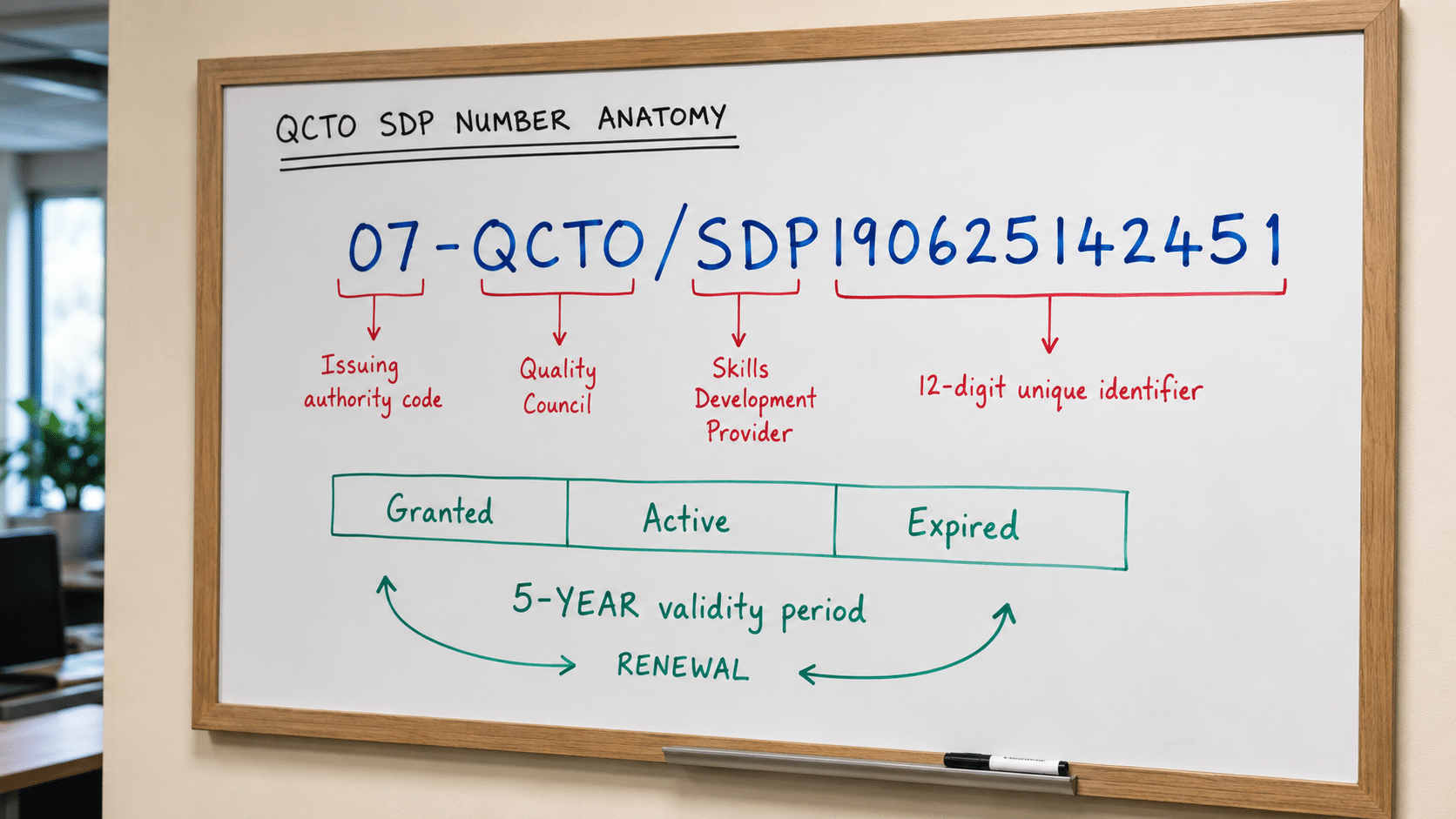
QCTO SDP accreditation is the regulatory permission that allows a training provider in South Africa to legally deliver occupational qualifications registered on the Occupational Qualifications Sub-Framework. The accreditation produces a unique SDP number that follows a fixed format — and that number is the single most useful artifact for verifying whether a provider is who they say they are.
This post breaks down the anatomy of the SDP number, the format every legitimate accreditation follows, the public register that confirms it, and the five-year validity rule that most corporate buyers don’t know about. For the broader context on how the QCTO framework actually works for accredited training in South Africa, see our complete guide to QCTO accredited training in Gauteng.
Quick Answer
QCTO SDP accreditation produces a standardised number in the format 07-QCTO/SDP followed by 12 digits — for example, 07-QCTO/SDP190625142451. The 07 prefix denotes QCTO as the issuing authority. SDP stands for Skills Development Provider. The 12-digit suffix is the unique identifier for the accredited entity. Accreditation is granted on a per-qualification basis — a provider accredited to deliver one occupational qualification is not automatically accredited for any other. Accreditation is valid for five years from the date of grant, after which it must be renewed through the QCTO’s annual evaluation process or the provider loses the right to deliver the qualifications they were accredited for. The SDP register on the QCTO website is the single authoritative source for verifying whether any claimed accreditation is real, current, and covers the specific qualification a corporate buyer plans to enrol learners against.
Need someone to confirm whether a provider’s SDP number is real and covers the qualification you want to enrol against?
Send the number through for verificationThe Anatomy of an SDP Accreditation Number
Every QCTO SDP accreditation number consists of three components stitched together into a single string. Phambili Village Campus, for example, operates under SDP number 07-QCTO/SDP190625142451. Each component carries specific regulatory meaning.
The 07 prefix is the issuing authority code that denotes QCTO as the body that granted the accreditation. This is the same prefix used across all QCTO-issued SDP numbers in South Africa. A claimed accreditation number that begins with a different prefix is not from the QCTO, regardless of any marketing claim.
The QCTO/SDP middle segment confirms the accreditation type — Skills Development Provider as opposed to Assessment Centre or other QCTO-accredited entity types. Assessment Centres carry a different segment in this position, which matters because the EISA at the end of an occupational qualification is conducted by an Assessment Centre that must be a different legal entity from the training provider.
The 12-digit suffix is the unique identifier assigned to the accredited entity. The digits are not random — they encode information about when the accreditation was granted and the sequence in which the entity entered the register. A buyer doesn’t need to decode the suffix, but they do need to confirm that the full number returns a match on the QCTO public register.
The 07 Prefix Test
If a claimed “QCTO accreditation” number does not begin with 07-QCTO/SDP, it is not a QCTO Skills Development Provider accreditation. Claims that begin with other prefixes might still be valid SETA accreditations or other quality assurance body credentials — but they will not authorise the entity to deliver occupational qualifications on the OQSF.
Why Accreditation Is Granted Per-Qualification, Not Per-Provider
One of the most consequential features of the accreditation framework — and one of the most commonly misunderstood — is that accreditation is granted qualification by qualification, not as a blanket licence to deliver anything occupational.
A provider accredited to deliver SAQA ID 91761 (Occupational Certificate: Electrician) is not automatically accredited to deliver SAQA ID 94021 (Mechanical Fitter) or any other qualification. Each occupational qualification on the OQSF requires its own separate accreditation application, with its own evaluation against the QCTO’s accreditation criteria.
The practical implication for corporate buyers is that the vetting question is not “are you QCTO accredited” — that question can be answered “yes” by any provider holding accreditation for a single qualification. The vetting question is “are you QCTO accredited for the specific qualification I want to enrol learners against.”
The SDP register entry shows both the provider’s accreditation status and the specific qualification IDs they are accredited to deliver. The two have to match for the accreditation to be valid for the cohort being contracted.
The Per-Qualification Vetting Question
Most providers will answer “yes” to “are you QCTO accredited?” — and most of them are telling the truth. But the question that protects the corporate buyer is the more specific one: “are you accredited to deliver SAQA ID [your qualification number]?” That question can only be answered honestly by checking the register entry, which lists exactly which qualifications the accreditation covers.
The buyer who asks the specific question first does not need a second meeting with the provider to clarify the answer.
For the official regulatory framework on how accreditation criteria are applied across qualifications, see QCTO’s official Skills Development Provider accreditation framework, which sets out the criteria, the validity period, and the de-accreditation rules at the regulator level.
The Five-Year Validity Rule That Buyers Often Miss
QCTO SDP accreditation is valid for a defined period — five years from the date the QCTO granted the accreditation, or until the provider is de-accredited, whichever comes first. The accreditation does not renew automatically. The provider must submit an annual evaluation and pay an annual accreditation fee to maintain their accreditation in good standing through the validity period, and a formal re-accreditation application before the validity expires.
The buyer-side question this creates is straightforward: when does the provider’s accreditation expire relative to your cohort’s completion date? A three-year occupational qualification cohort starting in 2026 will complete in 2029. A provider whose SDP accreditation expires in 2027 creates real risk that the certification cannot be issued at the end of the programme if their re-accreditation lapses or is denied.
The SDP register entry shows both the date accreditation was granted and the validity expiry date. Both dates matter, but for cohort planning purposes the expiry date is the one that controls. Confirm it against the cohort timeline before contracting — not after.
Want to map a planned cohort against the provider’s accreditation expiry to confirm certification will land on time?
Walk through the timeline scenarioHow to Verify QCTO SDP Accreditation on the Public Register
A public register of accredited Skills Development Providers sits on the QCTO website and is searchable from any browser. The register is the single authoritative source for verifying any claim — not the provider’s own marketing material, not third-party listings, not a screenshot of an accreditation letter.
A correct register search returns a record showing the provider’s legal name (the entity that holds the accreditation, which may differ from the trading name), the SDP number, the list of qualification IDs the provider is accredited to deliver, the date accreditation was granted, and the validity expiry date. If the search returns no match, the SDP number is either invalid, suspended, or expired.
What surprises most first-time buyers is how often the provider’s trading name differs from the accredited legal entity. The training company you receive a quote from may be marketing under one name while the entity actually holding the accreditation is a different registered company. A provider acting in good faith will explain this on first request. A provider hedging or evading the question is signalling something worth pushing back on.
What Happens When QCTO SDP Accreditation Goes Wrong
The QCTO holds explicit authority to withdraw QCTO SDP accreditation when a provider fails its obligations. The grounds for withdrawal include failure to perform responsibilities stipulated in the QCTO Accreditation Policy, contravention of the Skills Development Act, failure to submit the required annual evaluation, and failure to pay the annual accreditation fee within the prescribed period.
A withdrawn accreditation is a serious situation that ripples through every cohort the provider has in progress. Learners enrolled against the provider’s accreditation cannot complete the qualification through that provider, and the QCTO has to make alternative arrangements for the learners to be transferred to another accredited provider for the remaining components of the programme.
The vetting question this creates is harder to ask but more important to surface: has the provider ever had an accreditation withdrawn, suspended, or placed on remediation? The provider may not volunteer this in a sales conversation — but it is on the QCTO record. A buyer is entitled to ask directly, and a provider acting in good faith will answer directly.
How Phambili Approaches the SDP Accreditation Conversation
The Phambili Village Campus SDP number is published on every quote, every proposal, every email signature, and the website footer. The number is 07-QCTO/SDP190625142451. The accreditation covers the four QCTO occupational qualifications Phambili delivers — electrician, mechanical fitter, solar PV service technician, and welder — and the cluster of associated part-qualifications and skills programmes that support these trades.
Sharing the number proactively is not a marketing decision. It is the operating posture of a provider that wants the corporate buyer to verify the accreditation independently before the contract conversation deepens. A provider who requires the buyer to ask for the SDP number, or who shares it only after several rounds of email, is signalling a friction in the accreditation conversation that experienced corporate L&D buyers recognise immediately.
For the full picture of how the Phambili campus operates across the four QCTO qualifications, the staff team, the workshop facilities, and the host employer network, see the Phambili Village Campus homepage — which links through to each of the four occupational qualification programme pages.
The Before-and-After of Proper QCTO SDP Accreditation Verification
Skipping the SDP accreditation verification step is one of the cheapest possible cost savings in the contract process and one of the most expensive possible mistakes at certification time. The table below shows the typical gap between verified and unverified provider selection across the four high-leverage cost lines.
| Verification dimension | Before SDP register check | After SDP register check | Risk reduction |
|---|---|---|---|
| Accreditation reality | Marketing claim only | Verified register match | Provider is who they claim to be |
| Qualification scope match | Assumed cluster coverage | Specific qualification ID confirmed | Cohort can actually be enrolled |
| Validity timeline | Unknown expiry | Expiry date confirmed against cohort end | Certification will be issuable |
| Legal entity alignment | Trading name only | Accredited legal entity confirmed | Contract counterparty is correct |
When the SDP Accreditation Check Reveals a Provider Shouldn’t Be Shortlisted
The verification process is only useful if the buyer is willing to act on what the check reveals. The four scenarios below are the ones where the SDP check produces a hard fail and the right response is to disqualify the provider before any further contract conversation.
If the SDP number does not appear on the QCTO register at all
The QCTO register is the authoritative source. A claimed SDP number that returns no match is either invalid, fabricated, or refers to an accreditation that has been withdrawn. There is no benign explanation for this — the register either shows the accreditation or it does not. Move on to a different provider.
If the register entry shows the qualification ID is not covered by the provider’s accreditation
A provider may legitimately hold QCTO SDP accreditation but not for the specific qualification your cohort needs. Enrolling learners against a provider not accredited for that qualification means the EISA cannot be conducted and the certification cannot be issued through that provider. The cohort would need to be transferred to a different provider to complete — at the corporate buyer’s cost.
If the QCTO SDP accreditation validity expires before the planned cohort completion date
A three-year cohort starting in 2026 needs the provider’s accreditation to be valid through 2029 — including the EISA submission window after the formal programme end. Providers whose accreditation expires before the cohort completes need to confirm in writing that re-accreditation is in process and pre-approved, or the cohort risks not being certifiable through that provider.
If the accredited legal entity differs from the company quoting on the contract
The contract counterparty must match the accredited entity for the accreditation to apply to your cohort. A quote from “ABC Training Solutions” backed by an accreditation held by “ABC Holdings (Pty) Ltd” is a real risk if the two entities are structurally separate. Confirm that the contracting entity is the accredited entity before signature.
Frequently Asked Questions
What is the format of a QCTO SDP accreditation number?
The number follows the format 07-QCTO/SDP followed by 12 digits, typically written as a single string. The 07 prefix denotes QCTO as the issuing authority, QCTO/SDP confirms the accreditation type as Skills Development Provider, and the 12-digit suffix is the unique identifier for the accredited entity.
Numbers that do not follow this format are not QCTO SDP accreditations. They may be valid credentials from other quality assurance bodies (SETAs, professional councils, DHET registrations), but they do not authorise the entity to deliver QCTO occupational qualifications on the OQSF.
How long does QCTO SDP accreditation last?
The validity period is five years from the date the QCTO granted the accreditation, or until the provider is de-accredited, whichever comes first. The provider must submit an annual evaluation and pay an annual accreditation fee to maintain QCTO SDP accreditation in good standing through the validity period.
Re-accreditation is a formal application process that must be initiated before the validity expires. The accreditation does not renew automatically. Providers approaching the end of their validity period typically begin the re-accreditation process 12 to 18 months before expiry.
Can one QCTO SDP accreditation cover multiple qualifications?
Yes — but each qualification has to be granted accreditation individually. A provider can hold accreditation across multiple occupational qualifications, and the SDP register entry will list all the qualifications the accreditation covers. The accreditation number itself does not change as additional qualifications are added; the register entry expands to include the new qualification IDs.
What this means for buyers is that the SDP number alone does not tell you which qualifications the provider is accredited for. The register entry is the source of that information, and the specific qualification ID for your cohort must appear in the entry for the accreditation to apply.
Where can I find the QCTO public register of accredited Skills Development Providers?
The QCTO maintains a public register on its official website. The register is searchable by SDP number, provider name, and qualification ID, and returns the full QCTO SDP accreditation record for any match — including the qualifications covered, the date of grant, and the validity expiry date.
Third-party listings, directory sites, and provider marketing material are not authoritative sources. The QCTO public register is the only source that reflects the current accreditation status in real time. A discrepancy between marketing material and the register should always be resolved in favour of the register.
What happens if a provider’s QCTO SDP accreditation is withdrawn mid-cohort?
If the QCTO withdraws a provider’s accreditation while a cohort is in progress, the learners enrolled against that accreditation cannot complete the qualification through the de-accredited provider. The QCTO has protocols for arranging the transfer of affected learners to alternative accredited providers for the remaining components of the programme, but the cost and timeline impact of losing QCTO SDP accreditation mid-cohort falls on the corporate buyer.
For the corporate buyer funding the cohort, this is a real risk event — the per-learner economics get disrupted, the cohort timeline extends, and the relationship with the original provider becomes a recovery negotiation rather than a delivery relationship. The vetting checklist exists specifically to surface providers whose accreditation status carries elevated withdrawal risk before the contract is signed.
Is a provider’s SDP accreditation the same thing as their SETA registration?
No — these are different framework credentials, although a provider may hold both. QCTO SDP accreditation, granted under the post-2024 framework, authorises the delivery of occupational qualifications on the OQSF. SETA accreditation, granted under the previous unit-standards-based framework, authorised the delivery of legacy qualifications under specific sector-based skills authorities.
For new cohort planning against current occupational qualifications, the QCTO SDP accreditation is the credential that matters. For legacy provision still in the system under the SETA framework, the picture is more complex and worth confirming with the relevant SETA directly. A provider claiming “SETA accredited” against a current QCTO occupational qualification is conflating two different credentials.
Want a walkthrough of how to read a provider’s SDP register entry against your cohort’s qualification ID?
Get the verification walkthroughVerify a Provider’s QCTO SDP Accreditation Before You Contract
Phambili Village Campus operates under SDP number 07-QCTO/SDP190625142451 and works with corporate L&D teams through the accreditation verification process before every cohort contract. If you have a provider’s claimed SDP number you want to verify, a qualification ID you need to confirm against the register, or a cohort timeline you need to map against accreditation validity, the campus team can walk you through the check in under thirty minutes.
No obligation. We will get back to you within 24 hours.
Get in touch