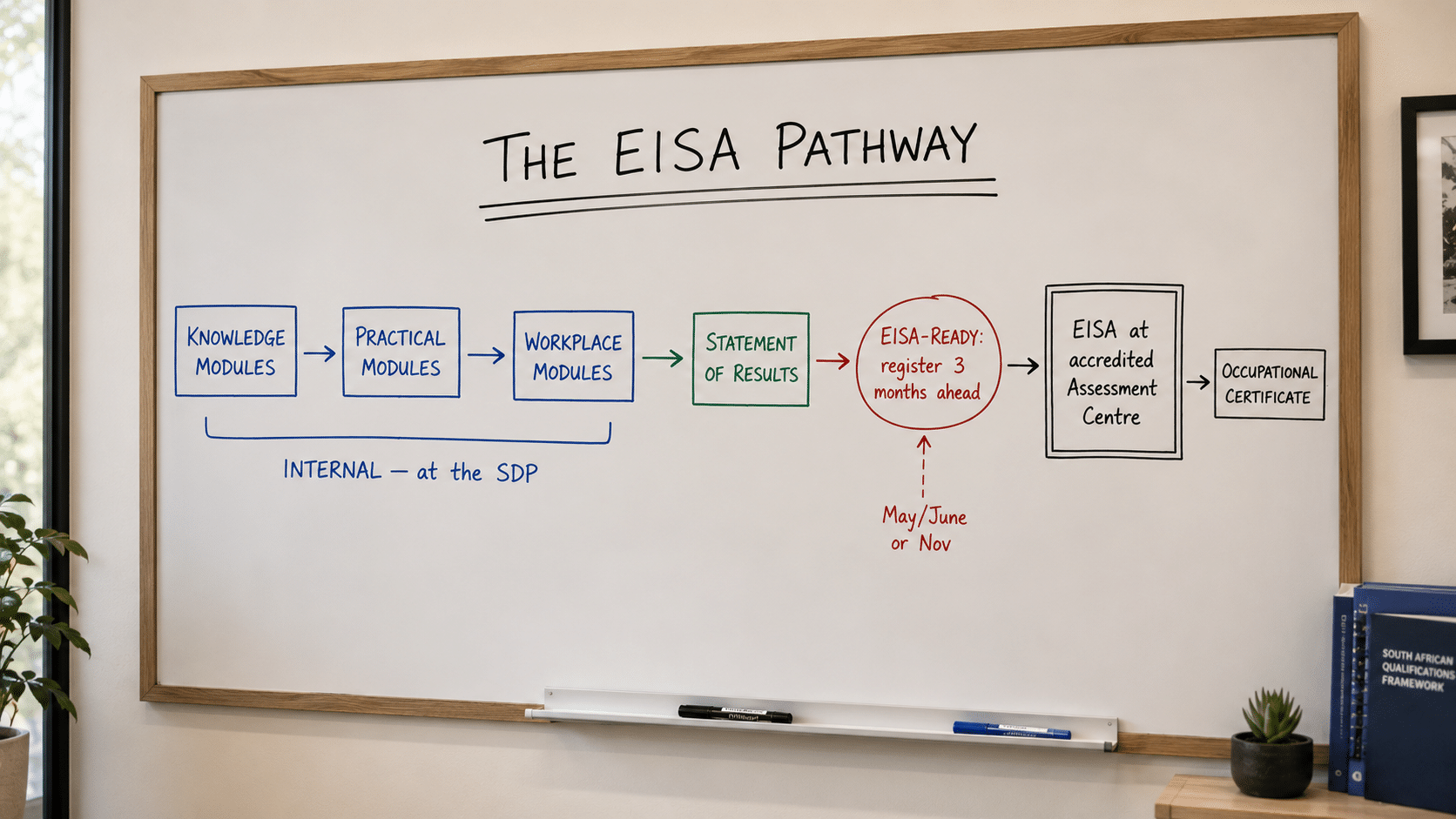
The external integrated summative assessment — known across the sector as the EISA — is the single national exam that stands between a learner and a QCTO occupational certificate. It is set and managed by an Assessment Quality Partner appointed by the QCTO, conducted at a separate accredited Assessment Centre, and it tests whether a learner can integrate everything they learned across the knowledge, practical, and workplace phases.
This guide demystifies the process — what it is, when it happens, what makes a learner eligible, and where cohorts most often come unstuck. For the wider framework this assessment sits inside, see our complete guide to QCTO accredited training in Gauteng.
Quick Answer
The external integrated summative assessment (EISA) is the final external exam in a QCTO occupational qualification, managed by an Assessment Quality Partner (AQP) and conducted at an accredited Assessment Centre that must be a separate entity from the training provider. A learner becomes eligible only after completing all knowledge, practical, and workplace modules and earning a Statement of Results for each.
The EISA tests integration — whether the learner can apply knowledge, practical skill, and workplace experience together — rather than recall. It is typically scheduled in May/June or November, and providers must register ready candidates with the QCTO at least three months ahead.
Need to understand where your cohort sits on the path to assessment readiness before the next registration window closes?
Check your cohort’s readinessWhat the Assessment Actually Tests
Older qualification types often assessed knowledge and skills in separate silos — a theory exam here, a practical task there. This assessment deliberately does the opposite. It presents the learner with scenarios that require pulling theory, hands-on skill, and workplace judgement together into a single response.
The reason for this design is simple: real work is integrated. An electrician on site does not face a “theory problem” and then a separate “practical problem” — they face a fault that requires understanding the principle, applying the skill, and exercising the judgement built up through workplace experience all at once. The assessment is built to mirror that reality, which is why it sits at the end rather than partway through.
The exam is strictly controlled by the QCTO and conducted under standardised national conditions, so a learner assessed in Gauteng faces the same standard as one assessed anywhere else in the country. That national consistency is part of what makes the resulting occupational certificate credible to employers.
Who Sets and Runs the EISA
Three distinct bodies have roles in the assessment, and keeping them separate is the point.
The Assessment Quality Partner (AQP) is the body the QCTO appoints to develop the assessment instruments and manage the external assessment for a specific qualification. The AQP signs a Service Level Agreement with the QCTO and is responsible for the integrity of the exam itself.
The Assessment Centre is the accredited venue where the exam is actually conducted. Critically, it must be a separate legal entity from the training provider. The people who taught the learner cannot be the people who conduct the final external exam — that separation is what makes the assessment genuinely external.
The Skills Development Provider (SDP) — the training provider — delivers the learning and conducts the internal assessments, but hands the learner over to the Assessment Centre for the final exam. The SDP’s job is to get the learner ready, not to assess the final competence.
| Body | Role | Relationship to Learner |
|---|---|---|
| Skills Development Provider (SDP) | Delivers training, conducts internal assessment | Teaches and prepares the learner |
| Assessment Quality Partner (AQP) | Sets exam instruments, manages the external assessment | Defines the standard the learner is measured against |
| Assessment Centre | Conducts the actual exam | Assesses the learner externally |
| QCTO | Oversees the system, issues the certificate | Certifies the learner on success |
Why the Separation Matters
The single design feature that gives a QCTO occupational certificate its credibility is that the people who train the learner are not the people who pass them. The training provider prepares the learner; an independent accredited Assessment Centre, working to instruments set by the Assessment Quality Partner, conducts the final exam. A buyer evaluating a qualification can trust that the certificate reflects an external judgement, not a provider grading its own work.
The Path to Becoming EISA-Ready
Eligibility is earned step by step through the qualification, and the sequence is strict — a learner does not simply book an exam. Each of the three components produces evidence that has to be formally recorded before the learner can be declared ready.
Every knowledge module, practical skills module, and workplace module must be completed and internally assessed by the provider. As each one is passed, the provider registers a Statement of Results against the learner’s name on the QCTO learner data system. Only once all the required Statements of Results are in place is the learner classified as ready for the external exam.
At that point, the provider submits the ready candidate’s details to the QCTO in the prescribed format, at least three months ahead of the scheduled assessment date. The assessment itself is then arranged by the AQP, typically in one of the two annual windows around May/June or November. Missing that registration window is one of the most common and most avoidable delays a cohort faces.
The Readiness Sequence
There is no shortcut to EISA-readiness. A learner needs a Statement of Results for every knowledge, practical, and workplace module before the provider can register them, and registration has to happen at least three months before the exam window. A cohort that leaves a single workplace module unsigned cannot be registered — which is why the workplace evidence has to keep pace with the classroom progress throughout the qualification, not get caught up at the end.
Want a clear map of which modules your learners still need signed off before they can be registered for assessment?
Map the readiness gapWhere Cohorts Come Unstuck Before the Exam
The assessment itself is rarely where things go wrong. The failures happen earlier, in the readiness pipeline, and they are almost always avoidable with disciplined tracking.
If a workplace module was never formally signed off
Someone can complete the classroom and workshop phases beautifully and still be ineligible because one workplace module never got a Statement of Results recorded. The QCTO system reads the missing SoR, not the learner’s actual competence. The fix is relentless tracking of every module’s sign-off as it happens.
If the provider missed the three-month registration deadline
Ready candidates have to be registered with the QCTO at least three months before the assessment window. Miss that deadline and the learner waits for the next window — often six months away. The cost is a half-year delay for an entirely avoidable administrative reason.
If the provider assumed it could conduct the final assessment itself
A provider’s final exam cannot be its own. The external assessment must be conducted by a separate accredited Assessment Centre, not the training provider. A provider that planned to “assess its own learners” at the end has misunderstood the model and will have no valid pathway to certification. The separation is non-negotiable.
If the learner was registered before all Statements of Results were in
Registering a learner who still has outstanding modules creates a record mismatch that the QCTO system rejects. Every required SoR has to be loaded before the registration is valid. Premature registration just creates rework and risks missing the window entirely.
How Phambili Gets Cohorts EISA-Ready
The Phambili Village Campus approach treats EISA-readiness as something engineered from the first week of a cohort, not assembled in a panic near the assessment window. Across the four QCTO occupational qualifications the campus holds — Electrician (SAQA 91761), Mechanical Fitter (SAQA 94021), Solar PV Service Technician (SAQA 99447), and Welder (SAQA 94100) — the campus team tracks every learner’s Statement of Results module by module as the qualification progresses.
The discipline that matters most is keeping the workplace module sign-offs moving in step with the classroom and workshop progress. Because the block release rhythm is coordinated with each host employer from intake, the workplace evidence accumulates throughout the qualification rather than being chased at the end. By the time a cohort approaches the assessment window, the Statements of Results are already in place and registration is a formality rather than a scramble.
For more on how the campus structures its qualifications and coordinates the workplace components that feed assessment readiness, see the Phambili Village Campus homepage, and the QCTO’s own outline of the process for assessment centres and the EISA.
What the Exam Day Itself Looks Like
For the learner, the assessment day is more structured than a typical workplace task and more applied than a typical school exam. The format is normally a set of written papers, conducted under controlled conditions at the accredited Assessment Centre and conducted in English. The questions are built around realistic occupational scenarios rather than abstract recall, so a candidate is asked to reason through a situation the way they would on site.
Because the venue is a separate Assessment Centre rather than the familiar campus, learners sit the exam in an unfamiliar setting with assessors they have not met. That unfamiliarity is deliberate — it removes any home-ground advantage and ensures every candidate nationally is measured the same way. A learner who has done the work across the qualification arrives able to handle the scenarios; a learner who coasted on internal goodwill has nowhere to hide.
The papers are then collected, marked, and moderated by the AQP under QCTO oversight before any result is released, which is why outcomes are not instant. The wait reflects the moderation rigour that gives the certificate its standing.
What Happens After the External Integrated Summative Assessment
Once the exam is written, the AQP marks and moderates the results under QCTO oversight. A learner who passes is recommended to the QCTO for certification, and the QCTO issues the occupational certificate — the nationally recognised qualification that confirms the learner is competent in the occupation. That certificate is what the whole qualification has been building towards, and it carries weight precisely because of the external assessment behind it.
Someone who does not pass is entitled to a defined re-assessment pathway, and there is a formal appeals procedure managed through the AQP for candidates who believe the result was incorrect. The exam is high-stakes, but it is not a single unrepeatable event.
The system is designed so a near-miss can be addressed without the learner losing everything they built across the qualification. The modules already signed off remain valid; only the external exam itself is repeated.
Planning a cohort and want to understand the full timeline from intake through to the assessment and certificate?
Walk through the full timelineFrequently Asked Questions
What does EISA stand for?
EISA stands for External Integrated Summative Assessment. It is the final external exam in a QCTO occupational qualification, conducted after the learner has completed all internal training and internal assessments. The word “integrated” signals that it tests the learner’s ability to combine knowledge, practical skill, and workplace experience in a single assessment rather than testing each in isolation.
Who conducts the EISA?
The exam is managed by an Assessment Quality Partner (AQP) appointed by the QCTO and conducted at an accredited Assessment Centre. The Assessment Centre must be a separate legal entity from the training provider that taught the learner. This separation is deliberate — it ensures the final assessment is genuinely external and not marked by the people who delivered the training.
When can a learner sit the EISA?
A learner becomes eligible once they have completed every knowledge, practical, and workplace module and earned a Statement of Results for each, recorded on the QCTO learner data system. The provider then registers the ready candidate with the QCTO at least three months before the scheduled assessment, which typically falls in a May/June or November window.
What happens if a learner fails the EISA?
A learner who does not pass is entitled to a re-assessment through the defined pathway, and there is a formal appeals procedure managed through the AQP for candidates who believe their result was incorrect. The learner does not lose the credit for the modules already completed; the re-assessment focuses on the external exam itself rather than repeating the whole qualification.
Can the training provider conduct the EISA itself?
No. The external assessment must be conducted by a separate accredited Assessment Centre, not the Skills Development Provider that delivered the training. The provider conducts the internal formative and summative assessments throughout the qualification, but the final external exam is deliberately handed to an independent Assessment Centre to preserve the integrity of the result.
How long before the exam does a provider need to register learners?
Skills Development Providers must submit their EISA-ready candidates to the QCTO at least three months ahead of the assessment window, in the prescribed data format. Missing this deadline usually means the learner waits for the next scheduled window, which can be around six months later, so the registration timeline is something a well-run provider tracks carefully against the module completion schedule.
Worried that the assessment will feel like a black box your learners walk into unprepared? In practice, the readiness comes from the cumulative evidence built across the qualification — a learner who has genuinely completed and been signed off on every module arrives at the exam having already demonstrated the competence the assessment confirms, rather than facing a surprise.
Map Your Cohort’s Path to the EISA
If you are running or planning a QCTO cohort and want a clear picture of the readiness pipeline — which modules need sign-off, when registration has to happen, and how the assessment window maps against your intake date — the Phambili campus team can lay it out against your specific qualification and cohort timeline. The output is a readiness roadmap from where your learners are now through to the occupational certificate.
No obligation. We will get back to you within 24 hours.
Get in touch