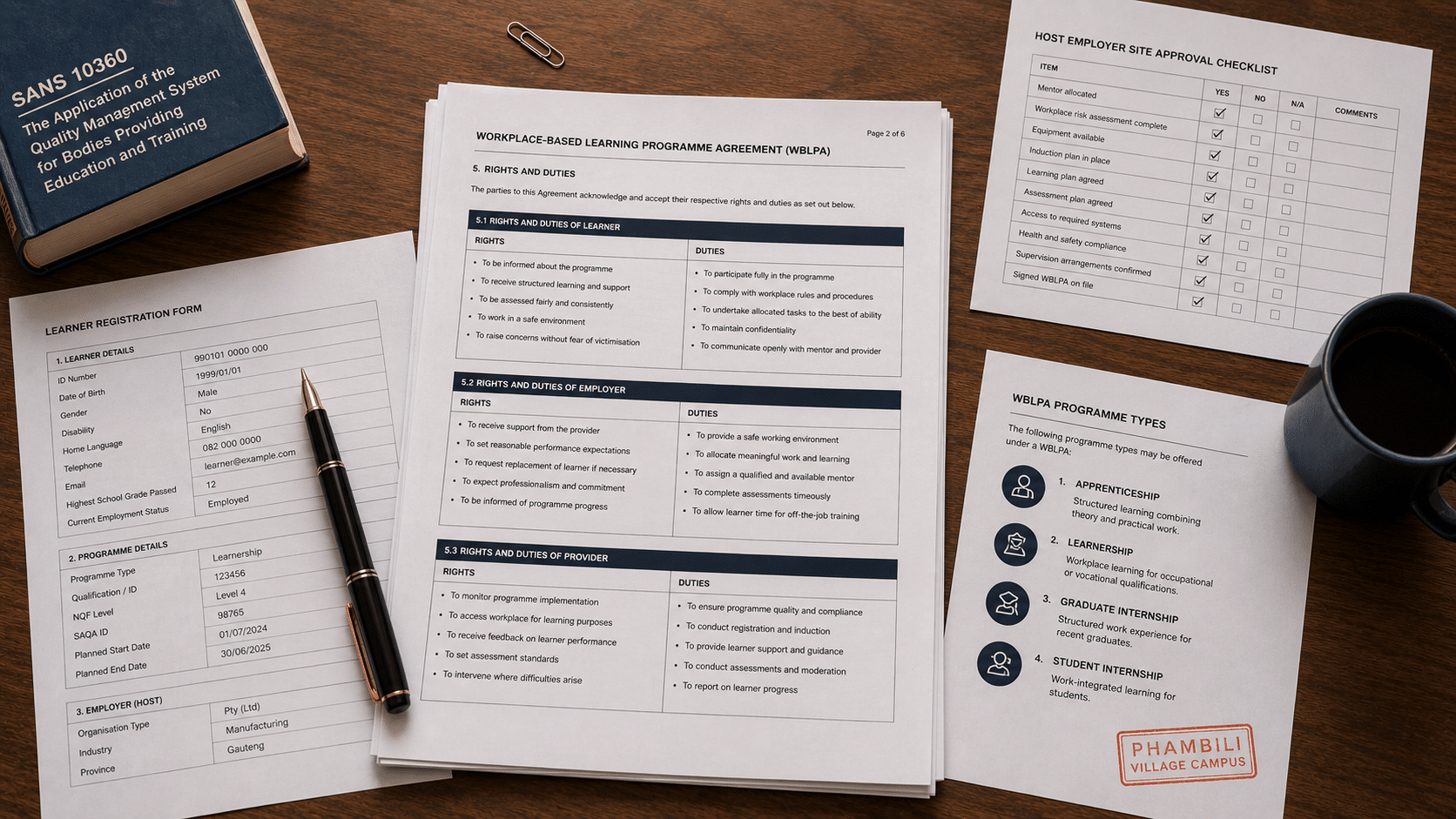
Workplace based learning is the single component of every QCTO occupational qualification that employers most often misunderstand. It is not “workplace experience”. It is not “internship”. It is a structured, contractually governed phase delivered under the Workplace-Based Learning Programme Agreement (WBLPA) — a tripartite legal instrument that replaced the old Learnership Agreement and now sits at the centre of every occupational training cohort.
This guide walks through what the agreement actually requires, what employers commit to when they sign, and how the on-site component runs in practice across the host employers Phambili Village Campus works with. For the broader picture of how QCTO occupational qualifications operate, see our complete guide to QCTO accredited training in Gauteng.
Quick Answer
Workplace based learning is the structured workplace component of a QCTO occupational qualification, governed by the WBLPA — a tripartite agreement between learner, employer, and accredited provider, signed under the SETA Workplace Based Learning Programme Agreement Regulations of 2018.
The WBLPA covers four programme types (Apprenticeship, Learnership, Graduate Internship, Student Internship), and the employer’s obligations are statutory once signed: provide a registered mentor, allow access to required work-experience tasks, keep records, and release the learner for the knowledge and practical phases.
Considering signing your first WBLPA as a host employer and want to know what you’re actually agreeing to before the meeting?
Walk through the agreementWhat the Agreement Actually Is
The Workplace-Based Learning Programme Agreement is a legal contract issued under the Skills Development Act 97 of 1998 and governed by the DHET Workplace-Based Learning Programme Agreement Regulations published in 2018. It replaced the old Learnership Agreement — the SETA-era instrument that previously governed workplace-based components for learnership cohorts.
Three parties sign every such agreement: the learner, the employer hosting the on-site component, and the QCTO-accredited Skills Development Provider managing the qualification. The agreement carries statutory weight — the regulations explicitly note that providing false or misleading information in the agreement is an offence under the Act.
One useful framing: the WBLPA does not create the learning programme. The QCTO occupational qualification creates it. The WBLPA defines who is responsible for what, across the three parties, over the duration of the on-site component. That distinction matters because employers sometimes treat the agreement as the qualification itself rather than as the contract that anchors one component of it.
The Four Programme Types the WBLPA Covers
The same agreement template applies across four distinct programme types, with the type selected on page one of the agreement. The choice changes the duration, the learner status, and the funding pathway, but the core obligations on the three parties remain consistent.
| Programme Type | Learner Status | Typical Duration | Common Use Case |
|---|---|---|---|
| Apprenticeship | Employed (apprentice contract) | 36 months | Trade qualifications (Electrician, Welder, Mechanical Fitter) |
| Learnership | Employed or unemployed learner | 12-36 months | Sector skills development against B-BBEE targets |
| Graduate Internship | Holder of post-school qualification | 6-24 months | Workplace exposure for tertiary graduates needing industry experience |
| Student Internship | Enrolled in SAQA-registered qualification | Variable, programme-bound | Component of an ongoing tertiary qualification |
For the QCTO occupational qualifications Phambili holds — Electrician, Mechanical Fitter, Solar PV Service Technician, and Welder — the agreement most often signs as either an Apprenticeship or a Learnership, depending on whether the learner is contracted as an apprentice or sponsored through a separate learnership arrangement.
The Programme Type Decision
The choice between Apprenticeship and Learnership on the WBLPA is not a paperwork preference — it affects the learner’s employment status, the funding mechanism, and the eventual B-BBEE category the spend lands in. Get the programme type wrong on the agreement and the verification audit will catch it eighteen months later. This is the conversation to have with the provider before the agreement is even drafted, not after.
What the Employer Actually Commits To
The employer’s obligations under the WBLPA are specific and statutory. They are not best-practice suggestions. Once signed, the agreement creates enforceable duties that apply for the full duration of the on-site component.
Provide a registered mentor. The employer commits to allocating a site supervisor who is competent in the occupation and available to the learner. The supervisor’s role is to supervise, sign off on completed work-experience tasks, and ensure the learner has access to the equipment and work environments required by the curriculum.
Allow access to required work-experience tasks. The qualification specifies a defined set of work-experience modules. The employer commits to ensuring the learner is rotated through, or given access to, the work environments where those modules can be completed. A learner in a switchboard manufacturing context who never sees a three-phase distribution board cannot complete the relevant module.
Maintain on-site records. The employer keeps logbooks, work-experience evidence, mentor sign-off sheets, and any incident or assessment documentation. The provider has the right to access the learner’s work experience records — that is in the agreement explicitly.
Release the learner for knowledge and practical phases. The WBLPA does not stand alone. The learner must attend the knowledge component (classroom theory) and the practical component (workshop practice) at the accredited provider’s facilities. The employer commits to release the learner for those blocks, which under a typical dual-system rhythm means alternating four-to-six week blocks across the year.
The Workplace Based Learning Component Inside a QCTO Qualification
Inside the broader qualification structure, the on-site component is one of three formal phases — knowledge, practical, and workplace. Each has a defined credit weighting on the qualification, and learners must complete all three before they qualify for the External Integrated Summative Assessment (EISA) that produces the occupational certificate.
For a QCTO Electrician (SAQA 91761) at NQF Level 4, the on-site component runs roughly 12 to 16 months of the 36-month total, depending on cohort rhythm. For a QCTO Welder (SAQA 94100), the equivalent share is similar. The workplace months are not “less rigorous” than the workshop months — they are where the learner consolidates knowledge against real production conditions, with assessment evidence captured against specific work-experience tasks listed in the curriculum.
One operator observation worth pausing on: employers who treat the on-site component as “the easy bit” — the months where the learner is just “on site getting experience” — end up with cohorts that struggle at EISA. The work-experience tasks have to be deliberately scheduled and signed off, not absorbed passively through general exposure. That deliberateness is what the agreement contractually creates.
Want to scope what the on-site component of a specific qualification would look like inside your operational rhythm?
Map the componentWhere the On-Site Component Goes Wrong at Audit
Verification audits in the post-2024 framework read the WBLPA documentation as carefully as they read the financial spend records. Four patterns show up repeatedly in audit findings.
If the WBLPA was signed after the learner started the on-site component
The agreement has to be in place before on-site exposure begins. Backdated signatures are a red flag for verification agencies and create real legal exposure under the Act. Sign at intake, before the first workshop day.
If the person named on the agreement isn’t the mentor actually doing the supervision
Workplace supervisor substitution happens — operational pressure moves people around. The fix is to update the WBLPA with the new supervisor’s details. An unchanged agreement with a phantom mentor name fails audit on a documentation check that takes the auditor about twenty seconds.
If the learner’s work-experience evidence doesn’t map to the curriculum modules
Logbooks full of “general workshop assistance” entries don’t evidence work-experience module completion. Each module has named tasks in the qualification curriculum, and the on-site evidence has to map against those named tasks. Generic time-served logbooks fail this check.
If the release schedule for knowledge and practical blocks isn’t honoured
The employer commits in the agreement to release the learner for the provider’s training blocks. Operational pressure that keeps a learner on-site through a scheduled block leaves a gap in the knowledge or practical component that has to be made up elsewhere. The agreement is the protection for both learner and provider against that operational pressure.
The Audit Pattern
Verification audits read the WBLPA documentation chain in a defined sequence — agreement signature date against cohort start date, named mentor against actual mentor, work-experience evidence against curriculum module list, release schedule against block dates. Each of these is a documentation check that takes the auditor two or three minutes. A cohort that survives all four checks holds the spend; a cohort that fails one of them puts the entire line item at risk.
How Phambili Structures the Workplace Component Across Host Employers
The Phambili Village Campus approach to workplace based learning runs through a coordinated host employer model rather than learner-finds-own-placement arrangements. The campus team takes responsibility for matching learners to host employers whose operational profile maps to the work-experience modules in the qualification curriculum, and for sustaining the relationship through the on-site months.
For the four QCTO occupational qualifications Phambili holds — Electrician (SAQA 91761), Mechanical Fitter (SAQA 94021), Solar PV Service Technician (SAQA 99447), and Welder (SAQA 94100) — the host employer network is selected against the specific module requirements of each qualification, with supervisor capability assessed upfront before any cohort is placed.
For corporate L&D buyers, this means the workplace component arrives with the cohort design rather than as an afterthought. The WBLPA is drafted at intake, the supervisor relationship is established before on-site exposure begins, and the work-experience evidence rhythm is scheduled against the EISA deadline from day one. For more on how the broader campus model operates, see the Phambili Village Campus homepage.
The B-BBEE Implication of Getting Workplace Based Learning Right
The B-BBEE scorecard rewards spend on occupational qualifications more heavily than spend on shorter skills programmes, and the on-site component is one of the things that distinguishes an occupational qualification from a shorter programme. A cohort whose WBLPA is properly executed and whose on-site evidence is auditable contributes Category B, C, or D scorecard credit. A cohort whose on-site phase is informal or undocumented exposes the entire spend to verification challenge.
This is the reason corporate L&D teams that take the on-site component seriously consistently extract more scorecard credit per Rand spent than teams that treat it as administrative paperwork. The agreement and its supporting evidence are not bureaucratic overhead — they are the documentation chain that survives verification and converts training spend into B-BBEE points.
Need a worked walkthrough of how the on-site component on a planned cohort would map against your B-BBEE scorecard targets?
Run the walkthroughFrequently Asked Questions
Who signs the agreement?
Three parties sign every Workplace-Based Learning Programme Agreement: the learner, the employer hosting the on-site component, and the accredited Skills Development Provider managing the qualification. The agreement is tripartite by design — none of the three can be omitted.
For learnership variants where a separate sponsor funds the learner, the sponsor may also appear on the agreement, but the core three signatories remain.
What is the difference between an agreement of this kind and a Learnership Agreement?
The WBLPA replaced the Learnership contract under the 2018 SETA Workplace Based Learning Programme Agreement Regulations. The old Learnership Agreement was specific to learnership-type programmes. The WBLPA is a unified template that covers four programme types — Apprenticeship, Learnership, Graduate Internship, and Student Internship — with the programme type selected on the agreement itself.
The substantive obligations on learner, employer, and provider are similar in shape to the old Learnership Agreement, but the structure is more standardised and the programme-type coverage is broader.
Does workplace based learning have to happen at the employer’s own premises?
Not necessarily, but the location has to be operationally appropriate to the qualification. A QCTO Welder cohort needs access to welding equipment and welding work — those are the work-experience tasks the curriculum requires. The employer named on the WBLPA commits to providing that access, whether through their own premises, a contracted site, or a partnership arrangement explicitly recorded on the agreement.
What does not work is a notional employer who signs the agreement but has no operational capacity to deliver the work-experience tasks. Verification audits catch that pattern quickly.
How long does the on-site component run inside a QCTO qualification?
Duration varies by qualification. For a QCTO Electrician occupational certificate at NQF Level 4, the on-site component typically runs 12 to 16 months of the 36-month total qualification. For the QCTO Welder qualification, the equivalent share is similar. The Solar PV Service Technician at NQF Level 5 has a shorter on-site window proportional to its shorter total duration.
The exact months are defined by the qualification curriculum, not by the WBLPA. The agreement governs the contractual relationship; the qualification governs the time.
What happens if the learner moves to a different employer mid-cohort?
The existing WBLPA terminates and a new WBLPA needs to be drafted with the new employer. Work-experience evidence captured under the original agreement remains valid if it was properly signed off by the original mentor and documented at the time. The learner does not have to repeat work-experience modules already completed; they continue where the previous workplace exposure ended.
What does not work is an unwritten transfer where the learner moves but the original WBLPA stays in place. Verification will read the mismatch and challenge the entire cohort line item.
Does the employer have to pay the learner during the on-site component?
Yes, where the WBLPA is signed as an Apprenticeship or Learnership with an employed-learner classification. The Skills Development Act requires payment of a learnership allowance or apprentice wage during the on-site component, with the rate set sector by sector through relevant SETAs or sectoral bargaining arrangements.
Graduate Internship and Student Internship variants have different payment arrangements depending on the funding model. The financial obligations follow the programme type selected on the agreement and should be confirmed against the relevant sector’s stipend or wage guidance before the agreement is signed.
Worried that taking this component seriously will create administrative overhead the line managers won’t accept? In practice, the documentation rhythm — supervisor sign-offs, monthly logbook reviews, work-experience evidence collection — takes about thirty minutes per learner per month once the system is in place. The cost of doing it properly is small. The cost of an audit challenge against an undocumented workplace component is much larger.
Walk Through an agreement of this kind Setup for Your Next Cohort
If you are planning a learnership or apprenticeship cohort and need to understand exactly what the Workplace-Based Learning Programme Agreement will commit you to before you sign, the Phambili campus team can walk through a sample agreement, the supervisor capability framework, and the evidence rhythm in a forty-five minute session. The output is a clear read on what your operational commitment will look like across the on-site months.
No obligation. We will get back to you within 24 hours.
Get in touch