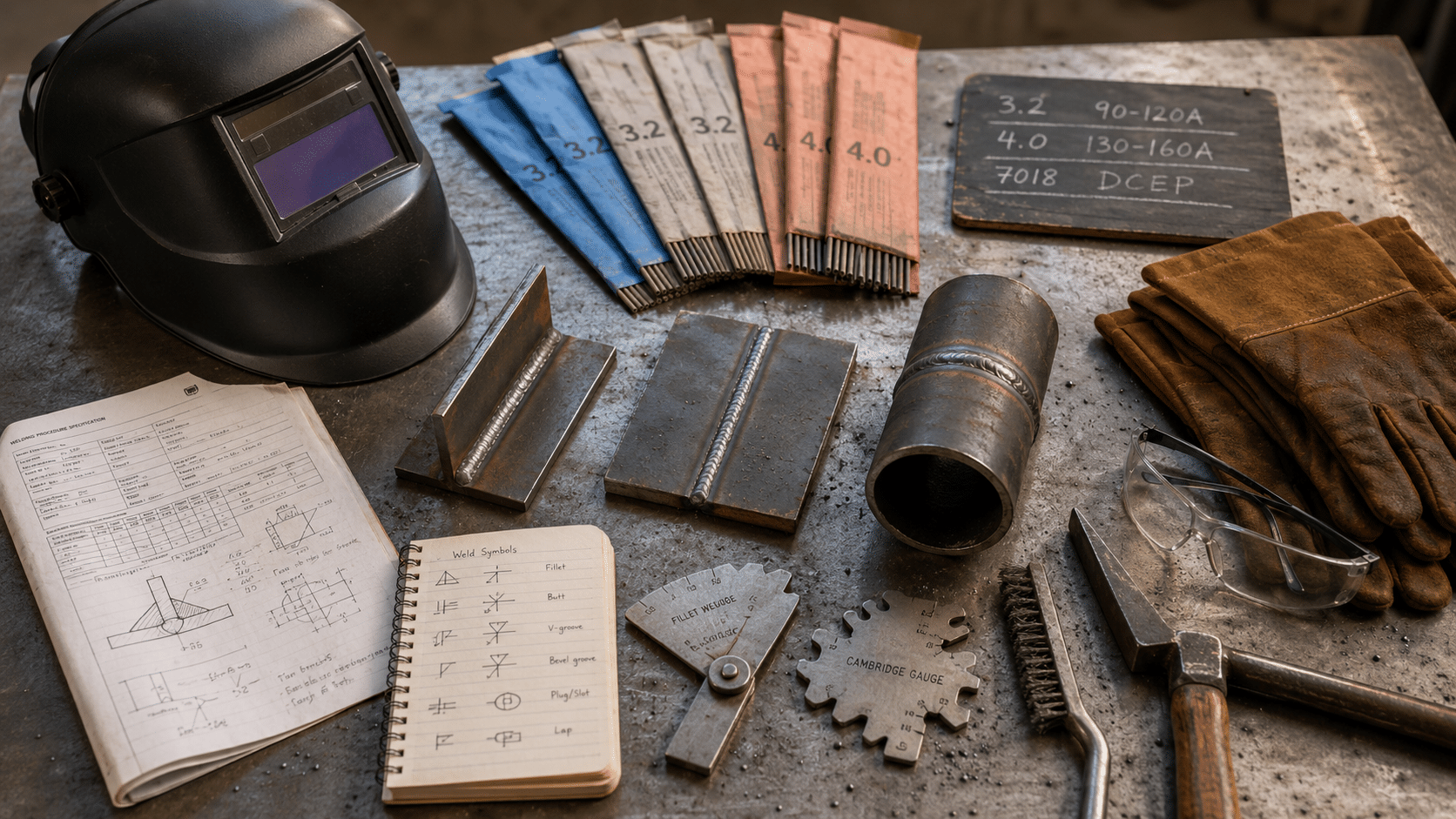
QCTO welder course Gauteng programmes lead to SAQA ID 94100 — Occupational Certificate: Welder at NQF Level 4, weighted at 373 credits. The qualification is structurally aligned with the International Institute of Welding’s minimum requirements, which is why a learner who completes it can pursue international welder recognition through the IIW pathway rather than getting stuck at the South African border.
For corporate L&D buyers and B-BBEE skills development teams scoping a welding artisan pipeline, the qualification has become the formal foundation of any serious welder development plan in South Africa.
This complete guide to the QCTO welder course Gauteng pathway covers the curriculum’s progressive skill-set architecture, the trade test mechanics, the coded welder pathway that stacks on top, and where the qualification slots into B-BBEE compliance planning. For the broader picture across all four Phambili qualifications, see our complete guide to QCTO accredited training in Gauteng.
Quick Answer
A QCTO welder course Gauteng learner registers against SAQA ID 94100 — Occupational Certificate: Welder at NQF Level 4 — and completes 373 credits across knowledge modules (welding theory, codes, metallurgy, distortion control), practical workshop modules following the IIW-aligned Fillet Welder → Plate Welder → Pipe Welder progression across MMA, MIG/MAG/FCAW, and gas welding processes, and a workplace experience component at a host employer site. The qualification is assessed through a 2-day trade test at a QCTO-accredited Assessment Centre administered through the National Artisan Moderation Body, with successful learners earning Red Seal recognition. From there, the SAIW coded welder pathway adds the specialist procedure qualifications that high-stakes sectors like petrochemical and power generation require.
Scoping a welder cohort intake for a fabrication or pressure-vessel manufacturing operation and need to map the qualification path?
Speak to the Phambili admissions teamThe Three-Tier Skills Architecture That Defines the Qualification
What distinguishes the welder qualification from the other three QCTO artisan trades Phambili delivers is the way the practical curriculum is structured. The qualification follows the internationally accepted progressive development route for welders — Fillet Welder, then Plate Welder, then Pipe Welder. Each tier is a recognised competence level on its own, and a learner can validly stop at any tier if their career direction supports it.
The Fillet Welder tier covers the foundation joints — T-joints, lap joints, and corner joints in the flat and horizontal positions. This is where the muscle memory for arc starts, electrode angle, travel speed, and weld pool control gets built. Most learners spend the longest portion of their workshop time here because everything above it depends on the foundation being right.
The Plate Welder tier adds the harder joint configurations — butt welds in plate, multi-pass welds, and welds in the vertical and overhead positions. This is where the qualification starts to demand the deeper procedural discipline that fabrication and structural work requires. A Plate Welder competent in 3F and 4F positions is employable across a much wider range of fabrication operations than a Fillet-only welder.
The Pipe Welder tier is the most demanding and the most economically valuable. Pipe welding requires the welder to maintain weld quality around the full circumference of the pipe, often in fixed positions where the welder cannot reposition for comfort. Sectors like petrochemical, power generation, and oil and gas pay a premium for competent pipe welders precisely because the skill takes years to develop and cannot be faked.
Why the Progressive Architecture Matters
The Fillet → Plate → Pipe progression is not a Phambili invention or a QCTO innovation. It is the international standard adopted by the IIW and reflected in welder qualification systems globally. A South African welder qualified to Pipe Welder level under the QCTO 94100 qualification has the foundational claim to international recognition through the IIW pathway — which is one of the structural reasons the qualification has long-term economic value beyond the South African border.
What the SAQA ID 94100 Curriculum Actually Covers
The formal title is Occupational Certificate: Welder, registered with SAQA at ID 94100 with curriculum code 651202000. The 373-credit weighting at NQF Level 4 implies roughly 3,730 notional learning hours across the qualification’s knowledge, practical, and workplace components.
The knowledge modules build from the foundational safety and theory layer through to the advanced welding science. Occupational Safety, Health and Environmental Protection sits in the foundation (NQF Level 2), alongside introduction to the welding trade, welding schematics and calculations, weld imperfections, and welding consumable classification.
The middle tier of knowledge modules covers metallurgy and weldability of metals, fusion welding theory, arc welding fundamentals, and gas welding and cutting (NQF Level 3). The advanced knowledge layer at NQF Level 4 covers welding codes, standards and parameters, shrinkage and residual stress and distortion management, and the process-specific modules for MMA welding and MIG/MAG/FCAW welding processes.
The practical skill modules follow the Fillet → Plate → Pipe progression and span the welding processes the qualification covers. MMA (Manual Metal Arc, also called Stick welding) is the foundation process most learners start on.
MIG/MAG (Metal Inert Gas / Metal Active Gas) adds the higher-productivity semi-automatic welding capability that modern fabrication operations rely on. Flux Cored Arc Welding extends the capability into thick-section and field welding. Gas welding and cutting rounds out the manual process knowledge.
The workplace experience component places the learner at a host employer site to perform real welding work under qualified supervision. Real production fabrication, on-site welding repair work, and structural fabrication are common workplace evidence contexts. Phambili matches learners to host employers whose operations align with the qualification’s workplace modules so the evidence the learner builds is genuine production work rather than fabricated exercises.
The Trade Test, the Red Seal, and What Sits Above
The final assessment of the QCTO welder qualification is structurally distinct from the EISA model used in the other three QCTO artisan trades Phambili delivers. The welder qualification is assessed through a 2-day trade test conducted under Section 26D of the Skills Development Act at a QCTO-accredited Assessment Centre, by an assessor registered with the National Artisan Moderation Body.
The trade test combines written assessment and practical tasks covering the critical aspects of the welder trade. The practical tasks are conducted in a simulated workplace environment — meaning real materials, real welding equipment, and real time pressure that approximate what the welder will face on a working fabrication shop floor.
A learner who passes the trade test earns the Occupational Certificate plus the Red Seal artisan designation that South African mining, manufacturing, and construction employers use as the de facto hiring credential.
Why the Welder Trade Test Sits Apart
The welder qualification is the only one of Phambili’s four QCTO trades where the final assessment is the trade test itself rather than an EISA followed by a separate trade test. This is a legacy of the welder qualification being designed from the outset around IIW-aligned international standards — the practical assessment IS the qualification gateway, not an additional step after.
Practically, this means there is no double-assessment timing question to manage at the planning stage. The 2-day trade test produces the Red Seal directly, which is why welder cohorts can be scheduled with cleaner certification milestones than the EISA-then-trade-test trades.
The Red Seal is the floor of professional welder recognition, not the ceiling. Above it sits the SAIW coded welder pathway — process-specific procedure qualifications that certify a welder as competent to a specific Welding Procedure Specification on a specific material in a specific position.
A welder qualified to ASME IX, ISO 9606, or AWS D1.1 for a specific WPS commands significantly higher day rates than an uncoded Red Seal welder. For the broader regulatory and certification framework see SAIW’s welding training and certification framework.
The path from Red Seal welder to coded welder is not automatic. It requires the welder to pass procedure-specific qualification tests against the codes the sector requires — and each procedure qualification needs to be maintained through periodic continuity tests. The economic returns scale accordingly. Petrochemical and pressure-vessel welders qualified to ASME IX on multiple processes are among the highest-paid artisans in the South African economy.
Want to understand how a learner cohort can progress from Red Seal welder to coded welder over a 24-month window?
Map the coded welder progression pathwayWhat Drives QCTO Welder Course Gauteng Programme Cost and Compliance Stack
For corporate L&D teams modelling the per-learner economics of a welder learnership cohort, the qualification stacks across the same three compliance and incentive layers that any registered QCTO learnership does — Section 12H tax allowance, B-BBEE Skills Development scorecard contribution, and the SETA grant pathway through MERSETA.
The Section 12H allowance runs at R30,000 per qualifying learner per assessment year for an NQF Level 1-6 learnership, with R50,000 values for learners with disabilities, plus a matching completion allowance on successful completion.
Across the welder learnership term, the cumulative deduction can reach R90,000 to R120,000 per learner where the structural requirements are met — SETA-registered learnership, QCTO-accredited delivery, agreement entered into before 1 April 2027. For the granular mechanics see our cluster post on how SA employers claim the Section 12H learnership tax rebate.
What shifts the per-learner cost picture between providers is the same set of structural factors as the other trade clusters — workshop access, host employer placement, EISA assessment fees, and materials provision.
For welder training in particular, the consumables cost is meaningful and often understated in provider quotes. A learner working through the Fillet → Plate → Pipe progression burns through hundreds of kilograms of electrodes and filler wire across the qualification, and the gas costs for MIG/MAG and oxy-fuel work compound across the workshop blocks.
| Programme component | Before trade test (per learner) | After trade test pass (per learner) | Compliance gain |
|---|---|---|---|
| Section 12H allowance claimable | R0 (pre-registration) | R90,000–R120,000 cumulative | Tax deduction across the learnership |
| B-BBEE Skills Development points | Counted as spend only | Full spend + headcount + absorption | Up to 25 scorecard points contribution |
| Qualification status | Trainee welder | Qualified welder (NQF 4, 373 credits) | Red Seal artisan recognition |
| Coded welder eligibility | Not yet eligible | Eligible for SAIW procedure qualifications | Sector premium hiring credential |
How Phambili Structures the Welder Programme
Three operational decisions distinguish Phambili’s approach to the welder occupational certificate. The dual-system block release pattern integrates campus-based knowledge and workshop work with host employer placement blocks throughout the qualification term, rather than the sequential model where learners complete all classroom work before touching a welding torch.
The cohort sizing of 12-18 learners per intake matters for welder training in a particular way. Each learner needs their own welding bay with proper extraction ventilation to work safely, and each learner needs supervised time on the arc to build the muscle memory the practical assessments demand.
Cohorts much larger than 18 force welding bay sharing that compresses individual practice time; cohorts much smaller than 12 lose the peer-debugging benefit where learners critique each other’s weld profiles and learn to read weld appearance.
The third decision is the workshop equipment standard. Welder training is one of the most capital-intensive QCTO programmes precisely because every process the qualification covers needs its own equipment — MMA welding machines for stick work, MIG/MAG inverter sets with shielding gas, oxy-fuel cutting and welding stations, plus the testing equipment that supports proper weld evaluation.
Phambili’s workshop is equipped for the full process scope the qualification requires. For the full programme details and current intake calendar, see the QCTO Welder programme page.
Why Welder Skills Sit at the Top of the Mining and Manufacturing Shortage List
The strategic case for a welder learnership programme in 2026 is anchored in a simple structural fact — South Africa has been importing welders from other countries to address the local shortage for years, and the gap has not closed. The qualification specifically notes that reports of large numbers of welders contracted from other countries to address scarcity are common in the South African economy.
The demand drivers compound across multiple sectors. Mining maintenance contractors need fabricators and pipe welders for plant shutdowns. Power generation operations need coded welders for boiler tube repairs, turbine work, and pressure-vessel fabrication. Petrochemical operations need welders qualified to ASME IX and other process-piping codes. Manufacturing operations need MIG/MAG welders for assembly work. Construction operations need structural welders qualified to AWS D1.1 for steel building and infrastructure work.
What makes this strategically interesting for B-BBEE planning is the absorption side of the maths. A welder learner who completes the QCTO qualification and passes the trade test is typically immediately absorbable into the host employer’s permanent welding team — exactly the indicator that delivers the absorption bonus points on the B-BBEE Skills Development scorecard.
The market is hiring qualified welders, which means a well-managed learnership programme converts directly into the absorption bonus without requiring an external placement search.
Who Should NOT Take the QCTO Welder Route
The qualification is structured for a specific learner profile and a specific delivery rhythm. Several common assumptions about who fits the welder pathway are worth disqualifying before the contract is signed — because the cost of a mismatched placement falls heavier on the learner and the host than on the provider.
If you confuse welder with boilermaker
These are related but distinct trades with different qualifications. A welder joins metals together using welding processes — the QCTO 94100 qualification. A boilermaker designs and fabricates complex metal components, which involves welding but also extensive fitting, plating, rolling, and structural fabrication work. Boilermaking is a separate occupational pathway with its own qualification and trade test.
Enrolling a learner who wants to do structural fabrication into a pure welder pathway produces a learner who finishes the certificate but does not have the broader fabrication scope they actually wanted.
If you need a coded welder in 12 months
The Red Seal welder qualification is the foundation, not the coded welder credential itself. Coded welder status — qualified against a specific Welding Procedure Specification for a specific code (ASME IX, ISO 9606, AWS D1.1) — sits on top of the Red Seal and requires additional procedure-specific qualification testing.
The full pathway from learner intake to coded welder typically runs 36 months or more. Programmes that promise coded welder status inside a 12-month window are either misrepresenting the credential or skipping qualification components that the trade test will catch.
If your operation does only one welding process
The QCTO welder qualification covers MMA, MIG/MAG, FCAW, and gas welding across the Fillet → Plate → Pipe progression. The workplace experience component requires the learner to generate evidence across multiple processes and joint configurations. An operation that exclusively runs one process — say, only MIG/MAG on flat-position production assembly work — cannot generate the breadth of workplace evidence the qualification requires.
If you can’t accommodate the consumables and shielding gas budget
Welder training is consumables-heavy in a way that the electrician and mechanical fitter programmes are not. A learner working through the practical progression burns through significant volumes of electrodes, filler wire, shielding gas, and oxy-fuel cylinders across the qualification. Where the host employer is providing the workplace blocks, the production materials the learner uses become a real cost line that needs to be budgeted upfront.
The B-BBEE and Section 12H Stack for Welder Programmes
Where the welder learnership earns its place in a B-BBEE skills development plan is across the same three scorecard indicators that any registered QCTO learnership does. Training spend on black learners feeds the spend indicator (around 6% target on the Generic Codes). Learnership headcount feeds the learnership indicator separately. The absorption of learners into employment after completion feeds the bonus points indicator.
What makes the welder learnership particularly strategically attractive is the layered credentialing the qualification supports over the learner’s career. A learner completing the programme can stack multiple credentials over time — the QCTO NQF 4 occupational certificate first, the Red Seal trade test pass second, and then process-specific coded welder qualifications through SAIW as the welder progresses into higher-stakes sector work.
Each credential a welder adds increases their absorption value to the host employer and their day-rate value to subsequent employers. A well-planned welder learnership produces B-BBEE scorecard value at multiple points along the journey rather than only at the trade test completion.
For the detailed scorecard mechanics including the priority element sub-minimum penalty and the 3% versus 6% spend targets across different scorecards, see our cluster post on how the B-BBEE skills development scorecard math actually works.
Building a 24-month welder workforce strategy that gets from learner intake to coded welder capability and need to scope the credentialing timeline?
Open a workforce planning conversationFrequently Asked Questions
How long does a QCTO welder course Gauteng programme actually take?
The QCTO Occupational Certificate: Welder (SAQA ID 94100) at NQF Level 4 with 373 credits is typically structured as a three-year apprenticeship-style programme. The credit weighting translates to approximately 3,730 notional learning hours across knowledge, practical, and workplace components combined.
Programmes that advertise substantially shorter durations are typically delivering only a partial qualification, focusing on a single welding process rather than the full Fillet → Plate → Pipe progression, or skipping the workplace experience component that the trade test requires evidence for.
What is the difference between a QCTO welder and a coded welder?
The QCTO Occupational Certificate: Welder (SAQA ID 94100) plus a successful Red Seal trade test produces a “qualified welder” — competent against the full scope of the QCTO welder occupation. A coded welder is a qualified welder who has additionally passed procedure-specific qualification tests against a recognised code such as ASME IX, ISO 9606, or AWS D1.1 for a specific Welding Procedure Specification.
The Red Seal is the foundation. Coded welder status sits on top of it and requires ongoing maintenance through periodic continuity tests. Sectors like petrochemical, pressure-vessel manufacturing, power generation, and oil and gas pay premium day rates specifically for coded welders qualified to the codes their work requires.
Does a learner need Grade 12 to enrol in a QCTO welder course?
The published minimum entry requirement for SAQA 94100 is NQF Level 1 (Grade 9) with Mathematics and Physical Science. A full Grade 12 / Matric is not strictly required by the qualification standard, though some providers add their own selection criteria above the published minimum.
What matters more than paper qualifications at entry is the learner’s hand-eye coordination, manual dexterity, willingness to work in hot and physically demanding conditions, and the patience to develop the precise muscle memory the trade requires. Recognition of Prior Learning is available for learners with prior welding experience seeking accelerated entry or partial credit.
How does the trade test for the welder qualification actually work?
The welder trade test runs over a minimum of 2 days at a QCTO-accredited Assessment Centre, administered by an assessor registered with the National Artisan Moderation Body under Section 26D of the Skills Development Act.
The assessment combines a written component covering the welder knowledge modules with practical welding tasks conducted in a simulated workplace environment. The practical tasks test the learner’s competence across the relevant welding processes and joint configurations the qualification covers. A successful trade test pass produces the Occupational Certificate: Welder and the Red Seal designation.
What is the SAIW and how does it fit with the QCTO qualification?
The Southern African Institute of Welding (SAIW), established in 1948, is South Africa’s leading welding certification body and a founder member of the International Institute of Welding. SAIW operates an ISO 17025-accredited testing laboratory and provides IIW-aligned welder qualification, procedure qualification, and welding inspector certification services.
QCTO and SAIW certifications work together rather than compete. The occupational certificate is the formal NQF qualification that establishes the welder’s broad competence. SAIW credentials add the procedure-specific and code-specific qualifications that high-stakes sectors require on top of that foundation. Most working welders progressing into senior sector roles hold both.
Why does the workplace experience component matter so much for welders?
Welding is a craft skill that develops with time on the arc, not in classroom hours. The workplace experience component places the learner in a production fabrication or maintenance environment where they are welding under real time pressure, on real materials, against real quality acceptance criteria — which is the only place the trade-floor judgement that distinguishes a competent welder from a tested one actually develops.
A learner who has passed every workshop exercise but has never welded under production conditions typically struggles on the trade test in ways that surprise providers and hosts who undervalued the workplace block. Phambili matches learners to host employers whose operations can generate the breadth of welding evidence the qualification requires.
Scope a Welder Learnership Cohort for the Next Financial Year
Phambili Village Campus delivers the Occupational Certificate: Welder (SAQA ID 94100) through a dual-system block release model with on-site workshop facilities at the Modderfontein campus and host employer placement across the Gauteng fabrication, manufacturing, and mining maintenance markets. If you’re planning a cohort intake, vetting providers, or modelling the QCTO-to-coded-welder progression timeline for a fabrication workforce, the campus team can walk you through the delivery sequence and the per-learner economics.
No obligation. We will get back to you within 24 hours.
Get in touch