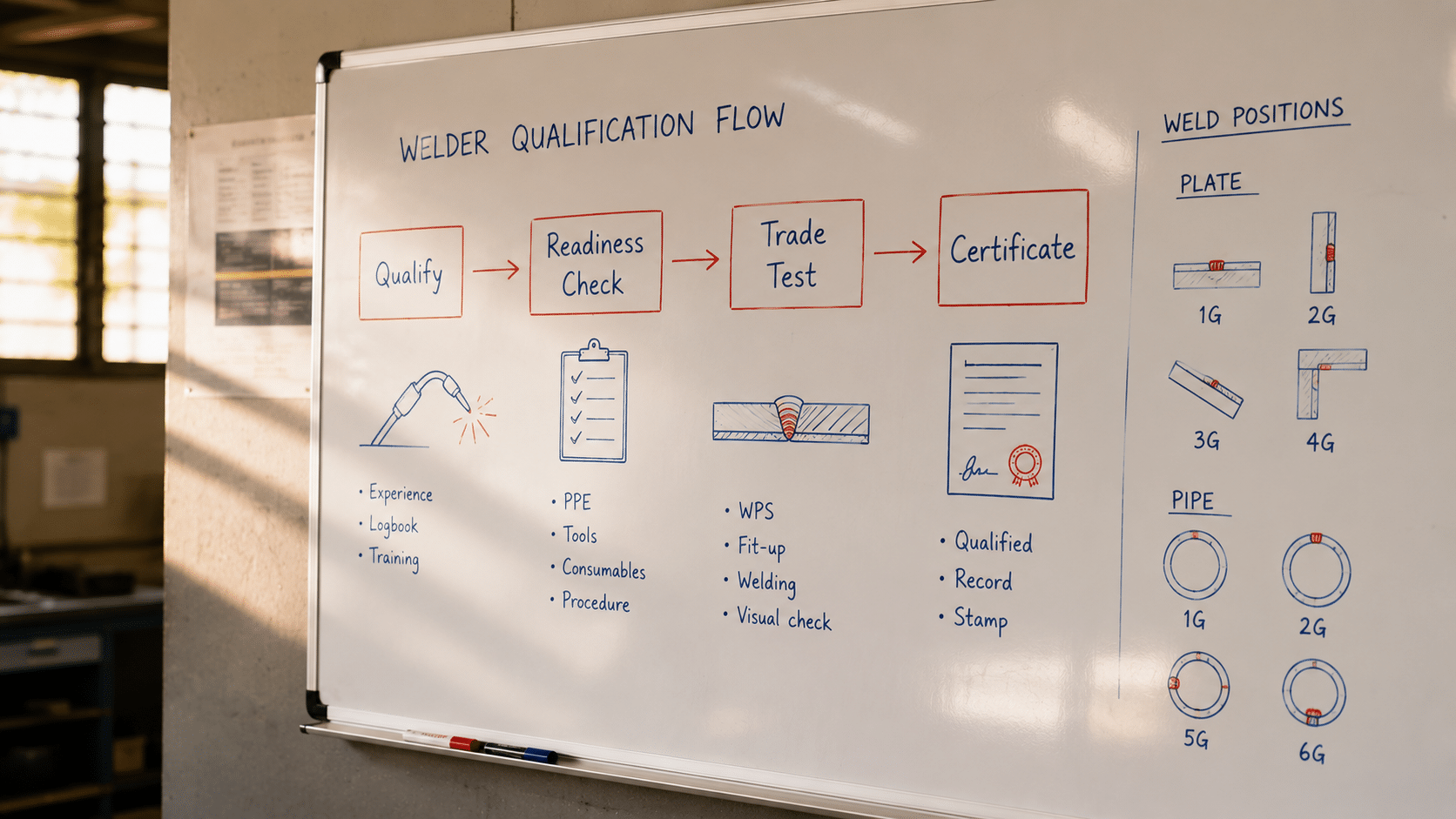
Welding trade test preparation is the work that turns a trained welder into a certified artisan — and it is mostly about readiness, not last-minute cramming. The trade test is the final hurdle of the welding qualification, so it makes sense to start with our guide to the QCTO Welder course in Gauteng to see where the test sits in the full journey.
This guide is for learners about to face the assessment, and for employers funding a cohort through it. It explains what the test contains, how the readiness gate works, and what genuinely moves the needle on the day. Once certified, many welders go on to specialise — our coded welder pathway guide covers what comes next.
Quick Answer
Welding trade test preparation means getting both ready and eligible: building the practical skill to weld the required joints to standard, drilling the trade theory, and passing the pre-trade-test evaluation that decides whether you may sit the test at all. The trade test is the final integrated summative assessment for the welding trade, conducted at an accredited centre, moderated by NAMB and certified by the QCTO.
Not sure whether your welders are ready to book a trade test date?
Talk it through with the campus teamWhat the Welding Trade Test Actually Involves
The trade test is not a single welding exam. It is a structured assessment with a theory component and a practical component, both of which must be passed, and it is the legal endpoint of the welding qualification under South Africa’s Trade Test Regulations.
On the practical side, you weld a set of prescribed joints in specified positions and processes, against a marking standard, often under time pressure. Welds are inspected visually and may be cut or bend-tested to check for internal defects. On the theory side, expect trade knowledge, interpretation of drawings, basic calculations and safety.
Behind the scenes sits a chain of oversight. The test is conducted at an accredited trade test centre, the result is moderated by the National Artisan Moderation Body, and certification is recommended to the QCTO. That is why a trade certificate carries weight: independent moderation stands behind it.
It helps to place the test inside the QCTO system. The welder is a listed trade, so its trade test serves as the final integrated summative assessment — the same gateway role the EISA plays for other occupational qualifications. We unpack that wider mechanism in our guide to the EISA.
| Component | What it covers |
|---|---|
| Pre-trade-test evaluation | Readiness gate — written and practical check to confirm you may proceed |
| Practical assessment | Prescribed joints, positions and processes welded to a marking standard |
| Weld inspection | Visual assessment, with bend or destructive testing for internal soundness |
| Theory assessment | Trade knowledge, drawing interpretation, calculations and safety |
| Moderation and certification | NAMB moderates the result; QCTO issues the national trade certificate |
The gate most people underestimate
The pre-trade-test evaluation is not a formality. It is an approved written and integrated practical check that determines whether a learner may proceed to the trade test at all. Treating it as the real dress rehearsal — and only booking the test once it is comfortably passed — is the single biggest lever in preparation.
Where Welding Trade Test Preparation Goes Wrong
Most trade-test failures are not mysteries. They cluster around a handful of avoidable causes, and naming them is the fastest way to sidestep them.
The biggest is booking too early. A welder who can produce a good weld on a calm afternoon is not the same as one who produces it reliably under assessment pressure. Consistency, not peak ability, is what the practical measures.
Close behind is neglected theory. Capable welders sometimes treat the written component as an afterthought and lose marks on drawings, calculations or safety they could easily have secured. The assessment is both halves, weighted to catch exactly that gap.
The quietest cause is unfamiliarity. Meeting the test format, the time limits and the marking expectations for the first time on the day rattles people who can plainly weld. Removing that surprise is most of what good preparation does.
The thread connecting all of these is preparation that mirrors the assessment instead of approximating it. Address those four causes, and most of the failure risk simply disappears.
Talent is rarely the missing piece here. That is the encouraging part — every one of these causes is fixable with preparation that takes the assessment seriously, which puts the outcome far more in the welder’s hands than test-day nerves suggest.
Welding Trade Test Preparation, Step by Step
Begin with honest readiness, not a booking date. The most common reason welders fail is sitting the test before their hands are consistent, chasing a deadline instead of a standard. Preparation works backwards from the marking criteria, not forwards from the calendar.
Drill the exact joints you will be assessed on. Generic welding practice is not the same as repeating the prescribed positions and processes until they are reliable cold, on a bad day, under a clock. The practical is about repeatable soundness, so practice has to mirror the test, not approximate it.
Do not neglect the theory. Strong welders sometimes stumble on drawing interpretation, calculations or safety questions because they assumed the practical was everything. Building the theory alongside the bench work, rather than the night before, is what keeps the whole assessment in reach. You can see how trade tests sit within the broader funding and qualification system through merSETA’s learning programmes.
Rehearse under real conditions before the real thing. Timed mock runs, marked honestly against the criteria, expose the weak joint or the slow setup while there is still time to fix it. A welder who has already faced the clock a few times walks in without that first-day shock.
Finally, treat the pre-trade-test evaluation as the goal first. Passing it confirms you are genuinely ready and unlocks the test booking. Welders who aim for that gate, rather than the test date, almost always arrive at the trade test calmer and better prepared.
Want a readiness check before your welders commit to a trade test date?
Ask us about a pre-test evaluationHow Long Welding Trade Test Preparation Takes
There is no single answer, and anyone who gives you one is guessing. Preparation time depends entirely on where a welder starts — current skill, consistency, and how much theory ground there is still to cover.
A welder finishing a structured qualification with strong, recent bench time may need only weeks of focused rehearsal. Someone returning to the trade after a gap, or self-taught with habits to unlearn, can need months. The honest measure is the readiness evaluation, not the calendar.
The useful reframe is to stop asking how long it takes and start asking what readiness looks like. Once a welder is comfortably passing mock assessments and the pre-trade-test evaluation, they are ready — whether that took six weeks or six months. Booking before that point is the expensive mistake.
Employers feel this most acutely. Setting a trade-test date around a project deadline instead of the welder’s readiness is how good people get set up to fail, and how a training budget ends up spent twice.
What to Expect on Trade Test Day
Test day rewards the prepared and punishes the flustered. Arrive early, bring your own personal protective equipment, and treat the setup as part of the assessment — a tidy, methodical start steadies the hands for everything that follows.
Expect to work to the marking standard under observation, with time tracked. The assessor is not there to coach; they are there to judge soundness against the criteria. Knowing that in advance keeps your focus on the weld in front of you rather than the person watching it.
And expect the theory to count. Whatever order the components fall in, both must be passed, so a strong practical will not rescue a weak theory paper. Walking in having prepared for the whole assessment is what separates a clear pass from a near-miss.
One small thing matters more than it should: composure. Nerves cost more marks than skill gaps at this stage, because a flustered welder rushes the setup and then chases a weld that has already drifted. Slowing down to do each step properly is, oddly, the fastest way through.
What Changes When a Learner Passes the Trade Test
Passing converts a learner into a qualified artisan with a national trade certificate — a recognised, portable credential rather than an in-house claim. That shift is the whole point of the assessment, and it changes how the labour market treats the person.
The comparison below is directional rather than a fixed promise; outcomes depend on the employer, the sector and the individual. It shows the change in standing that passing the trade test brings.
The real change is recognition. A learner’s skill might be excellent, but until the certificate exists it lives as a claim rather than a credential. Passing converts ability into something an employer, a SETA and a B-BBEE scorecard can all count.
| Metric | Before (learner) | After (qualified artisan) | Shift |
|---|---|---|---|
| Credential | In-training, no trade certificate | National trade certificate (QCTO) | Recognised artisan |
| Labour-market standing | Supervised, entry-level | Qualified, independently employable | Portable |
| Next step available | Limited | Coding and specialisation open up | Upward path |
| Employer value | Developing | Counts toward skills and B-BBEE goals | Scorecard value |
What passing unlocks
A national trade certificate is the foundation everything else builds on. It makes a welder independently employable, and it is the prerequisite for the higher-value coding that opens pressure-vessel, pipeline and structural work. The trade test is not the finish line — it is the gateway to the rest of a welding career.
Who This Preparation Guide Is NOT For
Being clear about who should pause matters here, because a premature trade test costs money and dents confidence when it does not need to.
You are still learning the basics
If your beads are still inconsistent and you are not yet welding the prescribed positions reliably, you are not preparing for a test — you are still training for the trade. Build the skill first; the test comes after, not instead.
You only want to practise the welding
Some welders prepare only at the bench and ignore the theory and the readiness evaluation. That gap fails people who can clearly weld. Preparation is the whole assessment, not just the part you enjoy most.
You are booking the test to hit a deadline
Sitting the trade test to satisfy a date rather than a standard is the classic mistake. The test does not get easier because a project needs you certified by month-end. Readiness sets the date, not the other way round.
How Phambili Gets Welders Test-Ready, Not Just Trained
There is a difference between teaching someone to weld and getting them through a trade test, and we build for the second. Phambili Village Campus runs the QCTO Welder occupational qualification with the assessment in mind from the start, so learners meet the marking standard long before they face it. The programme detail sits on our QCTO Welder programme page.
That focus is grounded in operator experience. As an accredited Skills Development Provider (SDP 07-QCTO/SDP190625142451), we have seen capable welders rattled by an unfamiliar process rather than a lack of skill — so we rehearse the readiness evaluation and the test conditions, not just the welds. Familiarity with the process is half the battle.
For Gauteng employers, that translates into fewer wasted test attempts and a more predictable pipeline of certified artisans. Knowing a learner is genuinely ready before a test date is booked protects both the learner’s confidence and the company’s training budget.
We also keep the post-test horizon in view. A learner who passes is immediately pointed toward what comes next — coding, specialisation, the work that pays more — so the trade certificate feels like a launchpad on the day it is earned, not just relief that the test is behind them.
Planning to put a cohort of welders through their trade tests this year?
Book a conversation with the campusFrequently Asked Questions
What is the welding trade test?
It is the final integrated summative assessment for the welding trade in South Africa, made up of a theory and a practical component. It is conducted at an accredited trade test centre, moderated by NAMB, and leads to a national trade certificate issued by the QCTO.
What is the pre-trade-test evaluation?
It is an approved written and integrated practical check that determines whether a learner may proceed to the trade test. Passing it confirms readiness and unlocks the test booking, which is why it should be treated as the real dress rehearsal.
How should I prepare for the welding practical?
Practise the exact joints, positions and processes you will be assessed on until they are reliable under time pressure, not just generic welding. The practical rewards repeatable soundness, so preparation should mirror the test conditions rather than approximate them.
Does the welding trade test include theory?
Yes. Alongside the practical, the assessment covers trade knowledge, drawing interpretation, calculations and safety. Strong welders sometimes fail on theory because they prepared only at the bench, so the theory must be built in advance.
Who certifies the welding trade test?
The test is conducted at an accredited trade test centre and the result is moderated by the National Artisan Moderation Body, which recommends certification to the QCTO. The QCTO then issues the national trade certificate.
What happens after I pass?
You become a qualified artisan with a recognised national trade certificate, which makes you independently employable. It also opens the coded welder pathway, where you certify to specific construction standards for higher-value work.
Still weighing how to get a welder genuinely ready rather than just booked for the trade test? That judgement is easier with someone who prepares learners for it every intake.
Get a trade-test readiness plan for your welders
Tell us where your welders are now and we will map what readiness looks like for the trade test, how the pre-test evaluation fits, and how certification supports your B-BBEE scorecard.
No obligation. We will get back to you within 24 hours.
Get in touch