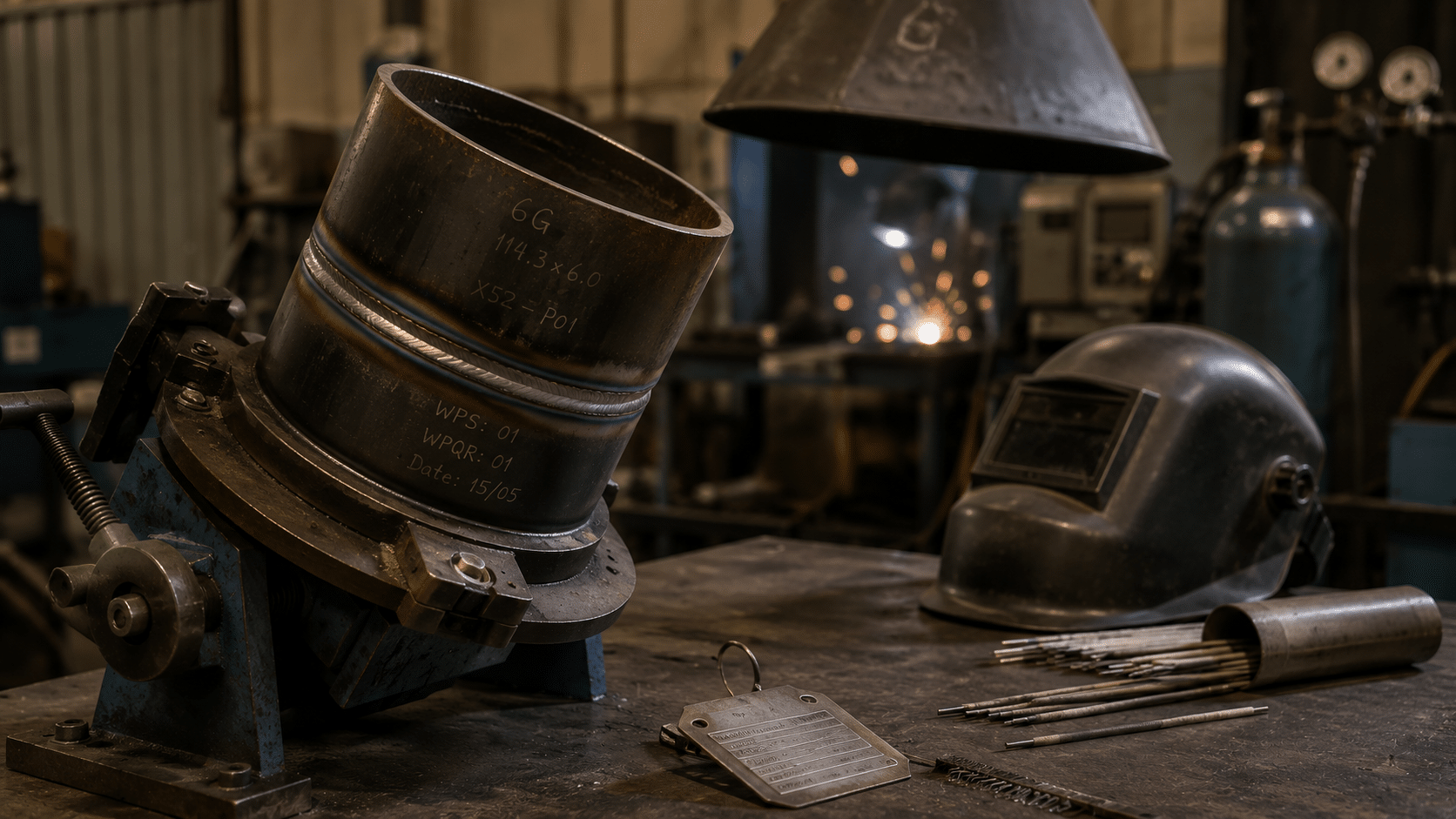
The coded welder pathway is the route a qualified welder takes to reach high-stakes work — pressure vessels, pipelines, structural steel — by passing performance tests against recognised welding standards. It starts from a solid foundation, which is why our guide to the QCTO Welder course in Gauteng is the right place to begin before anyone specialises.
This guide is written for two readers: the welder trying to push past entry-level pay, and the employer who needs certified hands for safety-critical fabrication. It maps the journey from a QCTO occupational qualification to specialised coding, and shows where bodies like the SAIW fit. For the wider accreditation picture, see our overview of QCTO accredited training.
Quick Answer
The coded welder pathway starts with a recognised welding qualification and a trade test, then adds performance certification — “coding” — for a specific process, position and material under a construction standard such as ISO 9606, ASME IX or AWS D1.1. Coding is what unlocks petrochemical, power-generation and structural work. It is procedure-specific and must be kept current, not earned once and forgotten.
Wondering how to take your welders from qualified to coded for site work?
Talk it through with the campus teamWhat “Coded” Actually Means for a Welder
Coding is not a single certificate you hang on a wall. It is proof that you can weld one defined procedure — a particular process, in a particular position, on a particular material and thickness — to a published standard, verified by a test piece that is inspected and often x-rayed. Change the variables and you may need a fresh test.
That precision is the point. A fabricator building a pressure vessel cannot take “I can weld” on trust. They need evidence that this welder, on this joint configuration, produces sound metal to the code their client demands. A coding certificate is that evidence, tied to named variables a welding inspector can check.
Because the certificate is bound to a procedure, it also lapses. Standards like ISO 9606 require ongoing evidence that the welder is still working in that range; let the continuity slip and the coding needs revalidating. A coded welder is not someone who passed once — it is someone currently certified.
The scrutiny behind it is real. A coding test piece is not eyeballed and waved through — it is typically subjected to non-destructive testing such as radiography or ultrasonic inspection, and sometimes destructive bend tests, before the welder is signed off. That independent inspection is exactly why coded work commands trust.
| Standard | Where it is typically required |
|---|---|
| ASME Section IX | Petrochemical industry — pressure equipment and piping |
| ISO 9606 | Power-generation industry and broad international work |
| AWS D1.1–6 | Structural fabrication industries |
The variables that define a code
A coding ties together the welding process (such as SMAW, MIG/MAG or TIG), the position (flat through to overhead and the 6G pipe position), the material group, and the thickness range. Move outside the qualified range and a new performance test is usually required. This is why experienced welders often hold several codes at once.
Why Coded Welders Are Scarce — and Well Paid — in South Africa
South Africa does not have enough coded welders, and the gap is expensive. When local certified welders are in short supply, large projects import them from other countries, which says plenty about where the bargaining power sits for those who hold current codes.
The demand is concentrated where failure is dangerous. Petrochemical plants, power generation, pipelines and heavy structural fabrication all need welds that carry code certification, and they will not compromise on it. A coded welder steps into that demand rather than competing in the crowded general-fabrication pool.
For employers there is a compliance angle as well. Funding a welder from a QCTO qualification through to coding is a substantial, registered skills-development investment — the kind that supports a B-BBEE scorecard while solving a real production bottleneck at the same time.
The shortage is not going away soon, either. South Africa’s energy build-out, refinery maintenance cycles and ongoing infrastructure work keep generating demand for certified welds faster than the training system produces certified welders. For an individual welder, that is unusual career security — a verified, scarce skill sitting in a market that consistently needs more of it than it can find.
A skill that is both scarce and hard to fake also tends to hold its value through downturns. The work that needs coded welds — keeping plants and pipelines safe — does not stop when budgets tighten, which gives the credential a resilience that more common qualifications lack.
That scarcity is exactly why the coded welder pathway is worth planning rather than stumbling into. Welders who map their codes to where the contracts actually are — instead of collecting random certificates — are the ones who stay booked.
The Coded Welder Pathway, Step by Step
Start with the foundation. A welder needs broad, assessed competence before specialising, which in South Africa means a recognised welding qualification and a trade test. Trying to skip to coding without that grounding tends to end in failed test pieces and wasted money.
From there, the work narrows. The welder builds hours in a chosen process and position, then sits a performance certification test at a recognised centre. You can see how this is structured through SAIW’s welder performance certification, which tests and codes welders to the construction standard most relevant to the job.
Which process and position you target matters strategically. A pipe welder certified in the 6G position — a fixed, inclined pipe — covers a wide range of easier positions in one test, which is why it is prized. Choosing where to specialise is part of walking the pathway well, not an afterthought.
Hours are the unglamorous truth of it. Coding tests reward muscle memory built over months of consistent welding in the target process, not a crash course the week before. Employers who give learners real time on the right joints produce welders who pass the test piece first time.
Cost follows the same logic of specificity. A standalone welder competency test is charged per welding process, per position, per material — in the region of R3,400 each, with a surcharge for stainless steel or aluminium. Treat that as indicative and confirm with the assessment centre, because every added process or position is a separate test.
Experience already earned is not wasted, either. A seasoned welder can often pursue certification through recognition of prior learning rather than repeating foundational training, taking the qualification tests more directly. The route bends to the person’s starting point rather than forcing everyone through the same door.
Want to map which codes your fabrication contracts actually demand?
Plan the certification route with usWhat Changes When a Qualified Welder Becomes Coded
The shift is from general employability to specific, billable trust. A qualified welder can do solid work across many jobs. A coded welder can be put on the joints that carry legal and safety weight — and that is where the rates and the steady contracts live.
The comparison below is directional rather than a fixed promise; real outcomes depend on the codes held, the industry and the employer. It shows the change in standing that coding brings on top of a sound qualification.
What really shifts is leverage. A general welder takes the rate offered; a coded welder, holding a scarce and verified skill, negotiates from a stronger position and gets first call for site mobilisation. That is the quiet economic engine behind the whole coded welder pathway.
| Metric | Before (qualified welder) | After (coded welder) | Shift |
|---|---|---|---|
| Work accessible | General fabrication | Pressure vessels, pipelines, structural steel | Safety-critical |
| Proof of competence | Qualification and trade test | Code tied to named procedures | Verifiable |
| Earning position | Standard fabrication rates | Higher, project-rate work | Stronger |
| Hiring demand | Broad pool | Sought for site mobilisation | Scarcer skill |
How to sequence it
For most welders the order is qualification first, codes second. Get the QCTO Welder occupational qualification and trade test done, build hours in a target process and position, then code to the standard your sector demands — ASME IX for petrochemical, ISO 9606 for power generation, AWS D1.1 for structural. Add further codes as the work requires them.
A code opens a door, but it does not walk the welder through it. The certificate has to be kept current and extended as the market moves toward new processes and positions. The route rewards momentum, which is why the first code is best treated as a beginning rather than a finish line.
From QCTO Welder to the Coded Welder Pathway
The subtitle of this whole journey is simple — a QCTO Welder qualification is the on-ramp, and coding is the highway. The occupational qualification builds the assessed, all-round competence; the codes then certify that competence against the specific procedures industry pays for.
Skipping the on-ramp is where people come unstuck. A welder who chases a code without the underlying qualification often lacks the consistency to pass under inspection, and has no broad credential to fall back on between contracts. The two layers are stronger together than either alone.
That is also the honest answer for welders hunting the fastest route. The fastest durable route is the deliberate one: qualify properly, build hours, then code. Shortcuts around the qualification tend to cost more in failed test pieces than the time they appear to save.
Who This Pathway Is NOT For
Honesty about who should wait saves real money here, because attempting coding at the wrong moment burns time and test fees that are charged per attempt — and every failed test piece is a fresh charge, not a free retry.
You have not built the hours yet
Coding tests applied skill on a specific joint under inspection. A welder without consistent practice in the target process and position will struggle to pass, and each failed test still costs money. Build the hours, then book the test.
You want one certificate to cover everything
Coding does not work that way. Each code is bound to a process, position and material range. Expecting a single test to make you universally employable misreads the system — breadth comes from holding several current codes.
You will not maintain continuity
A code lapses if you stop welding in that range. If your work will not keep you active in the certified procedure, the certificate quietly expires and needs revalidation. Coding rewards welders who stay in the work, not those chasing a once-off badge.
How Phambili Sets Up Welders for the Coding That Follows
We are deliberate about our place in this journey. Phambili Village Campus delivers the QCTO Welder occupational qualification — the broad, assessed foundation — and treats coding as the specialisation that comes after, usually through a dedicated certification body. You can see the programme on our QCTO Welder programme page.
That foundation is not a formality. As an accredited Skills Development Provider (SDP 07-QCTO/SDP190625142451), we have learned that welders who arrive at a coding test with genuine breadth — clean technique across positions, real understanding of the metal — pass more reliably than those rushed toward a single procedure. The qualification is what makes the later coding stick.
For Gauteng fabrication employers, that sequence is also a planning tool. Build a pipeline of qualified welders first, then code the strongest to the standards your contracts demand. It is cheaper and more reliable than hunting for ready-coded welders in a market that never has enough of them.
We also keep the coding endpoint in view while we teach. Knowing a learner may later sit an ASME IX or ISO 9606 test shapes how we drill positions and technique from the start, so the foundation already points toward the codes that follow rather than away from them.
We push employers toward sequencing, not shortcuts. There is no credible way to manufacture a coded welder overnight; there is a very credible way to build one deliberately from a sound qualification, and that is the conversation worth having before a deadline forces it.
Building a welding team for safety-critical fabrication work?
Book a conversation with the campusFrequently Asked Questions
What is a coded welder in South Africa?
A coded welder is one who has passed a performance certification test proving they can weld a specific process, position and material to a construction standard such as ISO 9606, ASME IX or AWS D1.1. The code is tied to those named variables.
Do I need a QCTO qualification before coding?
It is strongly recommended. Coding tests applied skill on a specific joint, so a recognised welding qualification and trade test give the broad competence needed to pass. Experienced welders may also use recognition of prior learning toward certification.
How much does welder coding cost?
A standalone welder competency test is charged per welding process, per position and per material, in the region of R3,400 each, with a surcharge for stainless steel or aluminium. Confirm exact pricing with the assessment centre, as each added variable is a separate test.
Which welding standard should I code to?
It depends on the industry. ASME Section IX is typically required in the petrochemical sector, ISO 9606 in power generation and broad international work, and AWS D1.1 in structural fabrication. Code to the standard your intended employer or sector demands.
Does a welding code expire?
Yes. Codes are bound to a procedure and require ongoing evidence that the welder is still working in that range. If continuity lapses, the certification must be revalidated. A coded welder is someone currently certified, not someone who passed once.
Can one coding cover all welding work?
No. Each code covers a specific process, position and material range. Welders who want broad employability hold several current codes, each earned through its own performance test against the relevant standard.
Still working out how to move welders from a QCTO qualification through to the codes your contracts demand? That plan is easier with someone who builds the foundation those tests rely on.
Get a welder coding pathway plan for your team
Tell us what your fabrication work involves and we will map how the QCTO Welder qualification feeds into the codes your sector requires, and how it supports your B-BBEE scorecard.
No obligation. We will get back to you within 24 hours.
Get in touch