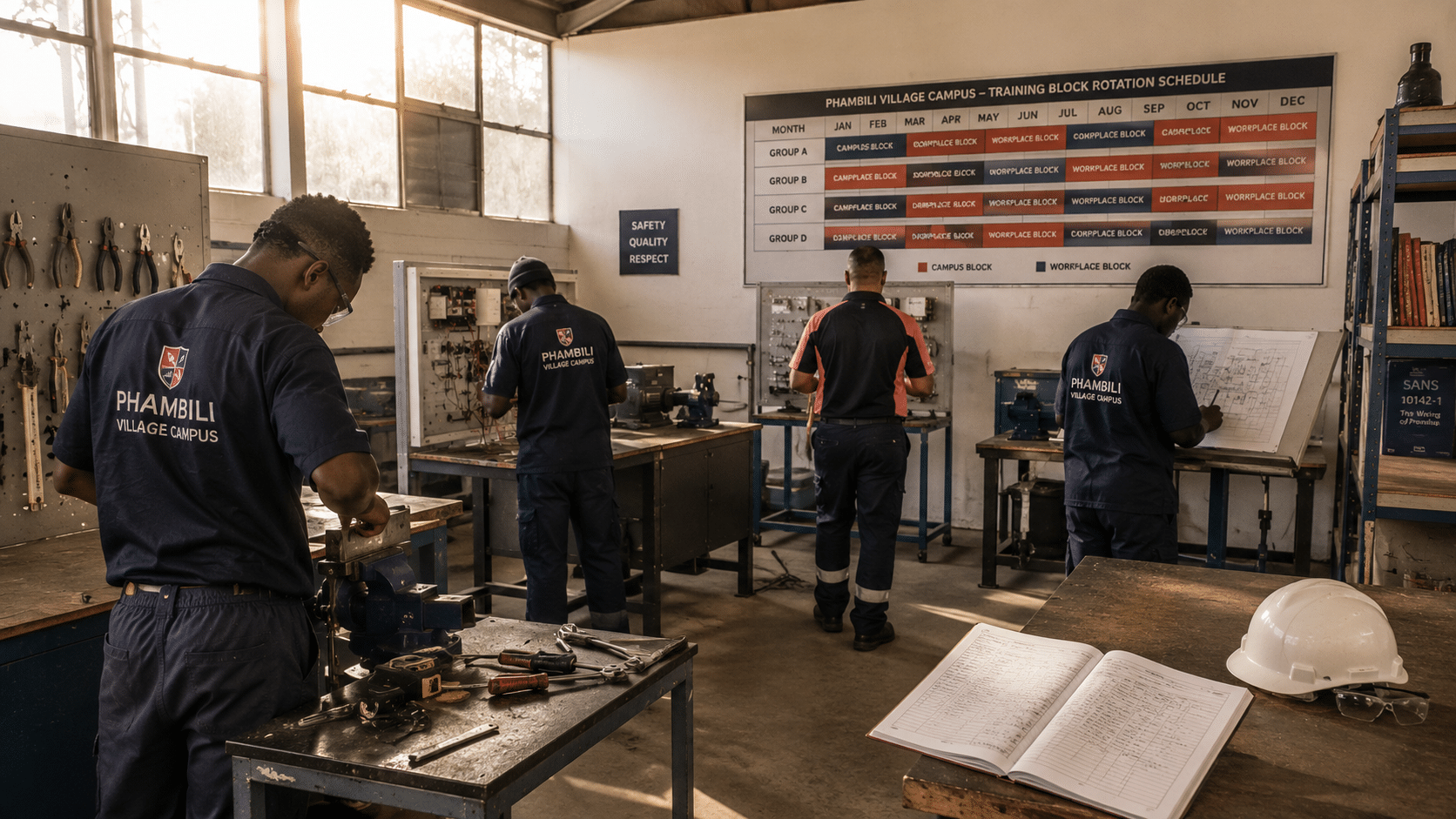
Dual system block release is the delivery model that lets a learner hold down a real workplace role while still completing the classroom and workshop phases of a QCTO occupational qualification. It alternates concentrated blocks at the training campus with concentrated blocks back in the workplace, rather than splitting every week between the two. For Phambili Village Campus, it is the operational spine of how all four trade qualifications are delivered.
This guide explains how the model actually works in practice — the rhythm, the coordination, and what employers experience when they place a learner into it. For the wider framework these qualifications sit inside, see our complete guide to QCTO accredited training in Gauteng.
Quick Answer
Dual system block release is a training delivery model where a learner alternates multi-week blocks at the training provider’s campus (knowledge and practical components) with multi-week blocks in the workplace (work experience component). The “dual system” name comes from the German vocational model that pairs structured institutional training with real workplace learning.
The “block release” element means the learner is released to the campus in concentrated blocks rather than one or two days a week, which suits employers whose operations cannot absorb a learner being absent every week.
Trying to work out whether the block rhythm will fit around your production schedule before committing a learner?
Map the rhythm to your operationWhere the Dual System Comes From
The dual system has its roots in the German vocational education tradition, where apprentices have long split their training between a vocational school and a host company. The model spread because it solves a problem that pure classroom training and pure on-the-job training each fail at on their own.
Classroom-only training produces people who know the theory but cannot do the work. Workplace-only training produces people who can do today’s job but cannot adapt when the work changes. Pairing the two settings is what produces an artisan who can both perform and reason.
South Africa’s occupational qualification framework adopted the same logic. A QCTO occupational qualification is built from three components — knowledge, practical skills, and workplace experience — and the QCTO overview of the Occupational Qualifications Sub-Framework sets out how these three integrate into a single qualification. The dual system is simply the delivery method that weaves those three components together over time.
What “Block Release” Actually Means in Practice
There are two common ways to deliver the institutional part of a qualification: day release and block release. On day release a learner attends the campus one or two fixed days each week across the whole year. Under block release, the learner attends in concentrated stretches — typically four to six weeks at a time — then returns to the workplace for an equivalent stretch.
For a working learner and a host employer, the difference is significant. A learner on day release is unavailable to the employer every single week, which fragments the work they can be given. A learner on block release is fully present in the workplace for a sustained period, completes meaningful work, then leaves for a campus block, then returns. The employer gets continuous productive stretches rather than a perpetually part-time presence.
Why the Block Matters Operationally
The choice between day release and block release is not just a scheduling preference. For most production environments — a workshop, a plant, a mine, a fabrication shop — a learner who disappears every Wednesday is harder to integrate into real work than a learner who is present for six straight weeks and then away for a defined block. The block model is what makes a working learnership viable in an operation that runs on continuity.
How the Three Components Map onto the Blocks
The knowledge component — the theory of the trade — is delivered in campus blocks, typically front-loaded earlier in the qualification. The practical skills component — supervised hands-on work in a controlled workshop — is also delivered in campus blocks, often interleaved with the knowledge blocks so theory and application reinforce each other.
The workplace experience component happens during the workplace blocks, where the learner applies the trade under real production conditions with a workplace mentor. Each setting does something the other cannot.
The sequencing matters. A learner who has just completed a campus block on a particular skill returns to the workplace able to practise it under real conditions. The next campus block then builds on what the workplace exposure revealed. Under dual system block release, the two settings are not running in parallel and ignoring each other — they are designed to feed each other across the qualification’s duration.
Not sure how the knowledge, practical and workplace blocks would sequence for a specific trade qualification in your sector?
Sequence it with the campus team| Component | Delivered During | Setting | Assessed By |
|---|---|---|---|
| Knowledge | Campus block | Classroom / theory room at the provider | Internal provider assessment |
| Practical Skills | Campus block | Controlled workshop at the provider | Internal provider assessment |
| Workplace Experience | Workplace block | Host employer site | Workplace mentor sign-off |
| Final Competence | After all three complete | Accredited Assessment Centre | External Integrated Summative Assessment (EISA) |
What Employers Experience Across a Year of Dual System Block Release
From the host employer’s side, a year of block release looks like a predictable cycle. The learner is on-site for a defined workplace block, contributing real work under mentor supervision and building logbook evidence against the work-experience tasks the curriculum requires. Then the learner leaves for a campus block, during which the employer plans around their absence the same way they would plan around any scheduled leave.
The predictability is the point. Because the blocks are scheduled at intake, the employer knows months in advance when the learner will be present and when they will be at the campus. There is no week-to-week uncertainty. A line manager can assign the learner to a multi-week project knowing they will be there to finish it.
One thing employers consistently underestimate is how much the campus blocks improve the workplace blocks. A learner comes back from a campus block with new skills that immediately raise what they can contribute on-site. The investment compounds rather than just consuming time.
That compounding is the quiet advantage this model has over sending someone on a one-off short course. The skill arrives, gets practised under real conditions, and is reinforced by the next block before it fades.
Want to see a sample block calendar mapped across a full qualification before you plan a cohort intake?
Request a sample calendarWhy Phambili Built Its Delivery Around Block Release
The Phambili Village Campus delivery model is built on block release across all four QCTO occupational qualifications — Electrician (SAQA 91761), Mechanical Fitter (SAQA 94021), Solar PV Service Technician (SAQA 99447), and Welder (SAQA 94100). The campus team coordinates the block calendar with each host employer at intake, so the rhythm is agreed before a single learner starts rather than negotiated reactively once the cohort is running.
The reason for the choice is operational realism. Most of the employers Phambili works with — across manufacturing, mining supply, fabrication, and renewable energy installation — run operations that cannot absorb a learner being absent one day every week, but can absorb a planned multi-week block.
Designing the delivery around concentrated blocks is what makes a Phambili learnership workable for the kinds of employers the campus serves, rather than only for employers with slack to spare. The model fits the operation rather than forcing the operation to fit the model.
For more on how the campus structures its qualifications and host employer network, see the Phambili Village Campus homepage, which links through to each programme.
Who Dual System Block Release Is Not the Right Fit For
The model is powerful, but it does not suit every situation. Being honest about where it does not fit is part of giving employers a real decision rather than a sales pitch.
If the employer needs the learner present every single working day with zero scheduled absence
Block release deliberately removes the learner for multi-week campus blocks. An operation that genuinely cannot release a person for any block at all is not compatible with a qualification that requires institutional training time. The qualification structure mandates campus components; there is no version that skips them.
If the workplace cannot provide the work-experience tasks the curriculum requires
A welder learner needs a workplace with welding work. If the host site cannot supply the actual tasks the curriculum lists, the workplace blocks become hollow, and the learner cannot complete the workplace component regardless of how well the campus blocks go. The workplace has to match the qualification.
If the employer wants a short upskilling course rather than a full qualification
Dual system block release is built for full occupational qualifications that run over many months. An employer who just needs a two-week refresher on a specific skill is better served by a focused skills programme, not a multi-block qualification structure. Match the delivery model to the actual training need.
The Block Release Rhythm and the EISA Deadline
Every block-structured qualification is ultimately working towards the External Integrated Summative Assessment — the single national assessment, conducted by a separate accredited Assessment Centre, that produces the occupational certificate. The block rhythm has to be sequenced so all three components are complete and signed off before the learner reaches the EISA.
This is where coordination matters most. A learner whose workplace blocks ran short on a particular work-experience task arrives at the EISA with a gap. The campus team’s job through the block calendar is to make sure the workplace evidence keeps pace with the knowledge and practical progress.
The learner should reach the assessment genuinely ready rather than nominally complete. Getting that rhythm right is the difference between a cohort that passes cleanly and one that stalls at the final hurdle.
The Coordination Discipline
The single biggest determinant of whether a block-structured cohort reaches the EISA ready is whether the workplace evidence kept pace with the campus progress. A learner can ace every campus block and still stall at assessment if the workplace tasks were not scheduled and signed off in step. The block calendar is not administrative scaffolding — it is the mechanism that keeps all three components moving together towards a single deadline.
Frequently Asked Questions
What is the difference between block release and day release?
Day release means the learner attends the training campus one or two fixed days each week throughout the year. Block release means the learner attends in concentrated multi-week stretches, then returns to the workplace for an equivalent stretch. Both deliver the same qualification components; they differ only in how the campus time is distributed across the year.
Block release generally suits production environments better, because it gives the employer sustained periods of full learner presence rather than a perpetually part-time arrangement.
Why is it called the “dual system”?
The term comes from the German vocational education model, which pairs two learning environments — a vocational school and a host company — into a single integrated qualification. The “dual” refers to those two settings working together. South Africa’s occupational qualification framework uses the same principle, with the training provider supplying the knowledge and practical components and the host employer supplying the workplace experience component.
How long are the blocks?
Block length varies by qualification and cohort, but campus blocks typically run four to six weeks at a time, alternating with workplace blocks of similar or longer duration. The exact rhythm is set by the qualification’s credit structure and the practical realities of the host employer’s operation, and is agreed at intake rather than improvised once the cohort is running.
Can a learner do a QCTO qualification without the workplace blocks?
No. A QCTO occupational qualification requires all three components — knowledge, practical, and workplace experience — to be completed before the learner is eligible for the External Integrated Summative Assessment. The workplace blocks are where the work-experience component is completed, and there is no pathway to the occupational certificate that skips them.
This is a fundamental difference from older qualification types where workplace exposure was sometimes optional or loosely defined.
Who coordinates the block schedule?
The accredited training provider coordinates the block calendar in agreement with the host employer, normally at the point of cohort intake. At Phambili, the campus team sets the rhythm with each host employer before learners start, so the schedule is predictable for the employer’s operational planning rather than negotiated reactively.
The learner, the employer, and the provider all work to the same agreed calendar for the duration of the qualification.
Does block release affect how the learner is paid?
Payment arrangements follow the programme type recorded on the Workplace-Based Learning Programme Agreement, not the block rhythm itself. Where the learner is contracted as an apprentice or employed learner, the agreed allowance or wage continues across both campus and workplace blocks. The block structure is a delivery method; it does not change the underlying employment or stipend arrangement, which should be confirmed against the relevant sector’s guidance before the cohort starts.
Worried that the campus blocks will pull a learner out of the operation at the worst possible moment in your production cycle? In practice, because the blocks are scheduled at intake, you choose the rhythm that aligns with your operational calendar — the campus team designs the block timing around your cycle, not against it.
Design a Block Release Rhythm That Fits Your Operation
If you are weighing up whether a dual system block release learnership can work around your production schedule, the Phambili campus team can map a sample block calendar against your operational cycle and show you exactly when a learner would be on-site versus at the campus across the full qualification. The output is a draft block schedule you can take to your operations team.
No obligation. We will get back to you within 24 hours.
Get in touch