Every SANS 10142 electrician in South Africa carries the wiring code with them on the job, whether they have a copy in the van or not. The document — formally SANS 10142-1, published by the South African Bureau of Standards — is the binding national standard that every electrical installation in the country has to comply with, and the only one a Certificate of Compliance can be issued against.
This guide walks through what SANS 10142-1 actually covers, why the Occupational Health and Safety Act makes it compulsory rather than optional, and where qualified electricians most often run into trouble with the parts of the code they thought they knew. For the wider qualification context, see our complete guide to the QCTO electrician course in Gauteng.
Quick Answer
A SANS 10142 electrician complies with SANS 10142-1, the South African national standard titled “The wiring of premises – Part 1: Low-voltage installations”. The current edition is SANS 10142-1:2024 (Edition 3.02), published by the SABS and made compulsory under the Occupational Health and Safety Act 85 of 1993.
Every electrical installation up to 1,000V AC must comply with this standard, and only a Registered Person who has passed the national examination may issue the Certificate of Compliance that attests to it.
Building a learner pipeline that walks out of training already comfortable with the practical end of the wiring code?
Plan the cohortWhat SANS 10142-1 Is, in Plain Terms
The full title gives most of the story away. SANS 10142-1 is “The wiring of premises – Part 1: Low-voltage installations”, a South African national standard developed and maintained by the SABS Standards Division through Technical Committee SABS/TC 067/SC 06 (Electricity distribution systems and components – Installations).
The current edition is 3.02, published in 2024, and it succeeds the 2020 Edition 3 and a long chain of revisions stretching back to the original SABS 0142 numbering.
The “Part 1” matters. SANS 10142-2 exists separately and covers medium-voltage installations between 1,000V AC and 22,000V AC, up to 3,000 kW installed capacity. Most of the work a domestic, commercial, or light-industrial electrician will ever touch is Part 1 territory — anything above that runs into the medium-voltage part of the same family of standards.
The legal mechanism that turns the standard from “best practice” into “the law” sits in the Electrical Installation Regulations 2009, issued by Government Notice R.242 of 6 March 2009 under the OHS Act 85 of 1993. The Regulations require that electrical installations comply with the code, and they require that only a Registered Person — Electrical Tester for Single Phase, Installation Electrician, or Master Installation Electrician — may certify that compliance.
The Five Areas Every SANS 10142 Electrician Has to Know
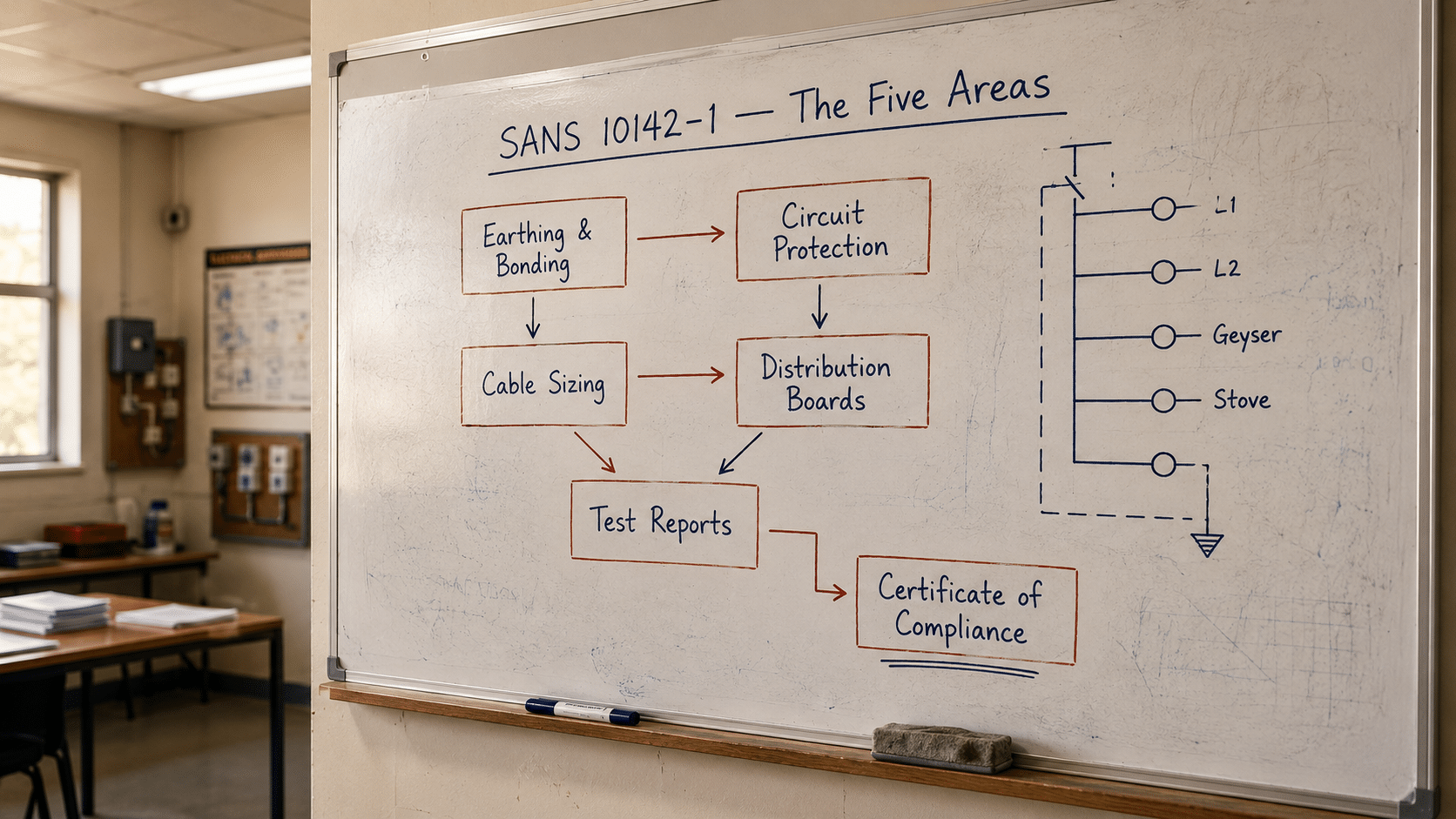
SANS 10142-1 runs to several hundred pages of detailed technical clauses, annexes, and tables, but the practical content for any qualified electrician falls into five recurring areas. Knowing which area a question belongs to is half the work of finding the answer in the document.
| Compliance Area | What the Code Governs | Common On-Site Decisions |
|---|---|---|
| Earthing and bonding | Earth electrode sizing, equipotential bonding, neutral-earth loop impedance | Earth continuity conductor sizing, supplementary bonding in wet areas |
| Circuit protection | Circuit breaker selection, RCD coverage, prospective short-circuit current | RCD vs MCB choice per circuit type, breaker discrimination on cascaded boards |
| Cable sizing and current capacity | Cable cross-section per current, voltage drop, derating for grouping and ambient temperature | Reading current-carrying capacity tables, voltage-drop calculations on long runs |
| Distribution board requirements | Board layout, labelling, accessibility, segregation of circuits | Spare-way provision, board labelling discipline, isolation switch positioning |
| Test reports and certification | Mandatory tests, test sequence, test report format, the Certificate of Compliance itself | Insulation resistance testing, earth continuity verification, polarity confirmation |
The 2024 edition added a sixth informal area — renewable energy integration — covering solar PV connections, battery storage interfaces, and electric vehicle charging socket-outlet requirements. The new SANS 164-2 socket-outlet configuration is now compulsory for all newly built homes, a change that has caught more than one electrician out on first-time inspection of a recent build.
The Five Areas in Practical Terms
Most queries an electrician will field on a job site come back to one of these five areas. Earthing questions live in clauses around section 6. Circuit protection sits in section 6.7 and the annexures on RCDs. Cable sizing runs through section 6.6 and the annex tables. Distribution boards are in section 6.8. Test requirements and the Certificate of Compliance test report sit at the back of the document. Knowing the area first cuts the lookup time by half.
Why the Standard Is Compulsory, Not Recommended
Some standards are advisory; this one is not. The Electrical Installation Regulations 2009 give the standard the force of law by making compliance with it a precondition for issuing a Certificate of Compliance, and by making the Certificate itself a legal requirement for occupied buildings under sale, lease, or material electrical alteration.
The chain runs like this. The OHS Act gives the Chief Inspector of the Department of Employment and Labour authority to administer occupational safety, including electrical safety. The Electrical Installation Regulations promulgated under that authority require compliance with the wiring code for every electrical installation.
The Certificate of Compliance is the legal artefact that confirms an installation meets the code. It must be issued by a Registered Person, and a Registered Person must pass the national examination before the DoL Chief Inspector will register them.
For more detail on the registration pathway that sits downstream of this knowledge requirement, see our guide to the wireman’s licence pathway after the QCTO electrician course.
To purchase the current edition, see the SABS catalogue entry for SANS 10142-1:2024 Edition 3.02. Hard copies are sold through the Sales Office at the SABS Head Office in Groenkloof, Pretoria; the electronic single-user PDF version is available via the Webstore.
Want to discuss how a SANS 10142 electrician literacy module fits inside a corporate apprenticeship programme without bloating the timeline?
Talk through the moduleWhat Changed in the 2024 Edition That a Qualified Electrician Should Know
SANS 10142-1 is amended regularly, and editions change frequently enough that an electrician who learned the code five years ago is working from a partly outdated picture. The 2024 Edition 3.02 carried forward most of the 2020 Edition 3 substance but added meaningful refinements that show up on actual jobs.
The headline changes from the 2020 revision onward are around renewable energy and EV charging. Provisions for the safe installation of plug-and-socket combinations for electric vehicle charging now reference the SANS 61851 and SANS 62196 series. The withdrawal of the British plug and socket-outlet (no longer manufactured or legal in South Africa) is reflected in the code.
Conduit references have been updated from the withdrawn SANS 60614 series to the SANS 61386 series. The electrical installation test report format has been updated to include the registered person’s name, contractor registration number, and registration expiry — a traceability change that matters when a fault appears years after the installation.
The compulsory SANS 164-2 socket-outlet configuration for new buildings is the change most likely to surface on inspection of a current-construction project. An electrician completing first-fix on a 2025 build who installs the older SANS 164-0 sockets has not failed at electrical work — they have failed at code currency.
Where SANS 10142 Electrician Compliance Most Often Slips on Site
The standard is not where electricians make most of their mistakes. Where the trouble lies is in the gap between knowing a clause exists and applying it correctly on a job that does not look quite like the textbook example. The patterns repeat enough that the same handful of failures account for most failed inspections.
The Four Recurring Compliance Failures
Earth continuity conductor undersized for the protective device on the circuit; RCD coverage missing on a circuit feeding a wet area or a socket-outlet outdoors; spare-way provision in the distribution board too tight to actually use; and a test report missing one of the mandatory tests at the back of the document. The standard catches all four, but only on the next inspection — by which point the certificate has been issued and the installation has been live for months.
Who Should Probably Read Something Else Instead
This guide is aimed at qualified electricians, learners in their workshop phase, and the corporate L&D teams that have to make decisions about training spend. A few audiences will get more from a different post on the campus blog.
If you are a homeowner trying to evaluate a Certificate of Compliance you have just received
The legal authority of the certificate is what matters to you, not the depth of the standard behind it. What you actually need to check is whether the issuing electrician is currently registered with the Department of Employment and Labour and whether the test report at the back of the certificate has the mandatory tests filled in.
If you are an electrical engineer working on system design rather than installation
The wiring code is the installation standard. The design-side standards live elsewhere — the SANS 61439 series for distribution board assemblies, the SANS 60364 family for IEC-aligned design, and a long list of component-level standards referenced in the SANS 10142-1 tables. The installation code assumes a competent design upstream of it.
If your work sits in medium-voltage territory rather than low-voltage
SANS 10142-2 is your reference, not Part 1. The two parts are managed under the same technical committee and share a common structure, but the medium-voltage code has its own clauses on switchgear, protection coordination, and earthing that do not appear in Part 1.
If you are still working toward the QCTO Electrician occupational certificate
Knowledge of the standard becomes a serious requirement when the trade test is in sight and the national examination is on the horizon. Earlier in the programme, the foundational work on circuits, instruments, and basic installation comes first. The standard is built into the later workshop and workplace components precisely because it makes more sense in the hands of someone who has wired a board.
How Phambili Builds SANS 10142-1 Literacy into the Workshop Phase
The Phambili Village Campus QCTO Electrician programme — Occupational Certificate: Electrician, SAQA 91761, NQF Level 4 — treats SANS 10142-1 as a working tool rather than a memorisation exercise. Workshop sessions are run with the current edition of the standard physically on the bench and learners are taught to navigate it the way a working electrician does on a job: by compliance area first, by clause number second.
The workplace component reinforces the same discipline. Every installation a learner does in their workplace block release rotation is logged against the relevant section of the standard, so by the time the national examination is on the calendar the learner has been working with the document for months rather than meeting it cold in a six-week prep course.
For the full picture of how the Phambili Electrician programme runs and how the workshop phase integrates with workplace block release, see the Phambili QCTO Electrician programme page.
Building an apprentice cohort and want a clear picture of where SANS 10142 electrician literacy fits across the programme phases?
See the literacy moduleFrequently Asked Questions
Is SANS 10142 the same as SANS 10142-1?
In informal use, electricians often refer to “SANS 10142” when they mean “SANS 10142-1”. It has two parts: SANS 10142-1 covers low-voltage installations (up to 1,000V AC), and SANS 10142-2 covers medium-voltage installations between 1kV and 22kV AC. Domestic, commercial, and most industrial work falls under Part 1. The Certificate of Compliance for a residential or office installation is issued against Part 1 specifically.
Which edition of SANS 10142-1 is currently in force?
The current edition is SANS 10142-1:2024 (Edition 3.02), published by the SABS. It replaces the 2020 Edition 3, which itself replaced the 2017 Edition 2 and a long sequence of amendments. Editions are revised regularly, so an electrician’s working knowledge needs to track changes — particularly around renewable energy integration, EV charging, and the SANS 164-2 socket-outlet configuration that became compulsory for new buildings.
Does an electrician need to own a copy of SANS 10142-1?
Yes, in practical terms. The standard is referenced by every Certificate of Compliance the electrician signs, by every test report attached to a CoC, and by every inspection. A working copy — either a hard copy purchased from the SABS Sales Office or an electronic single-user PDF from the SABS Webstore — is part of the kit. Training providers cannot supply learners with copies because of the standard’s single-user licence.
What is the SANS 10142-1 national examination?
The SANS 10142-1 national examination is the wiring-code knowledge test an applicant for Installation Electrician or Master Installation Electrician registration must pass before the Department of Employment and Labour will register them. The examination tests the applicant’s ability to navigate the standard, perform the calculations it requires (cable sizing, voltage drop, earth continuity), and identify compliance failures. Without a pass, the wireman’s registration application stalls regardless of how strong the trade test result was.
Does compliance with SANS 10142-1 cover everything an installation needs?
Mostly, but not always. The code is the installation-side reference. Some installations also touch the SANS 10400 building regulations, the SANS 60364 design references, and component-level standards for specific items like circuit breakers and socket-outlets.
The code references the other applicable standards through its normative table at the front of the document. The installation electrician’s job is to apply the installation code while assuming the upstream design and the components themselves comply with their own references.
How often is SANS 10142-1 updated?
The wiring code is amended on a rolling basis through SABS Technical Committee SABS/TC 067/SC 06, with major edition updates occurring every few years. Minor amendments are introduced more frequently and indicated in the document margin by amendment number. The practical implication is that an electrician working from a five-year-old copy is working from a substantially outdated reference, particularly on anything involving renewable energy, EV charging, or socket-outlet configuration.
Worried that staying current on SANS 10142 electrician compliance updates will turn into a permanent training tail your business has to fund? In practice, edition updates are gradual rather than sudden, and a half-day refresher session at edition changeover covers what an established electrician needs to know to keep their compliance discipline current.
Set Up a SANS 10142 Electrician Literacy Track for Your Cohort
If you are running an electrician apprenticeship programme or planning one, the Phambili campus team can design a wiring-code literacy track that runs in parallel with the QCTO occupational certificate — building working familiarity with the standard from the workshop phase through to the national examination, rather than treating it as a separate final-stage prep course.
No obligation. We will get back to you within 24 hours.
Get in touch